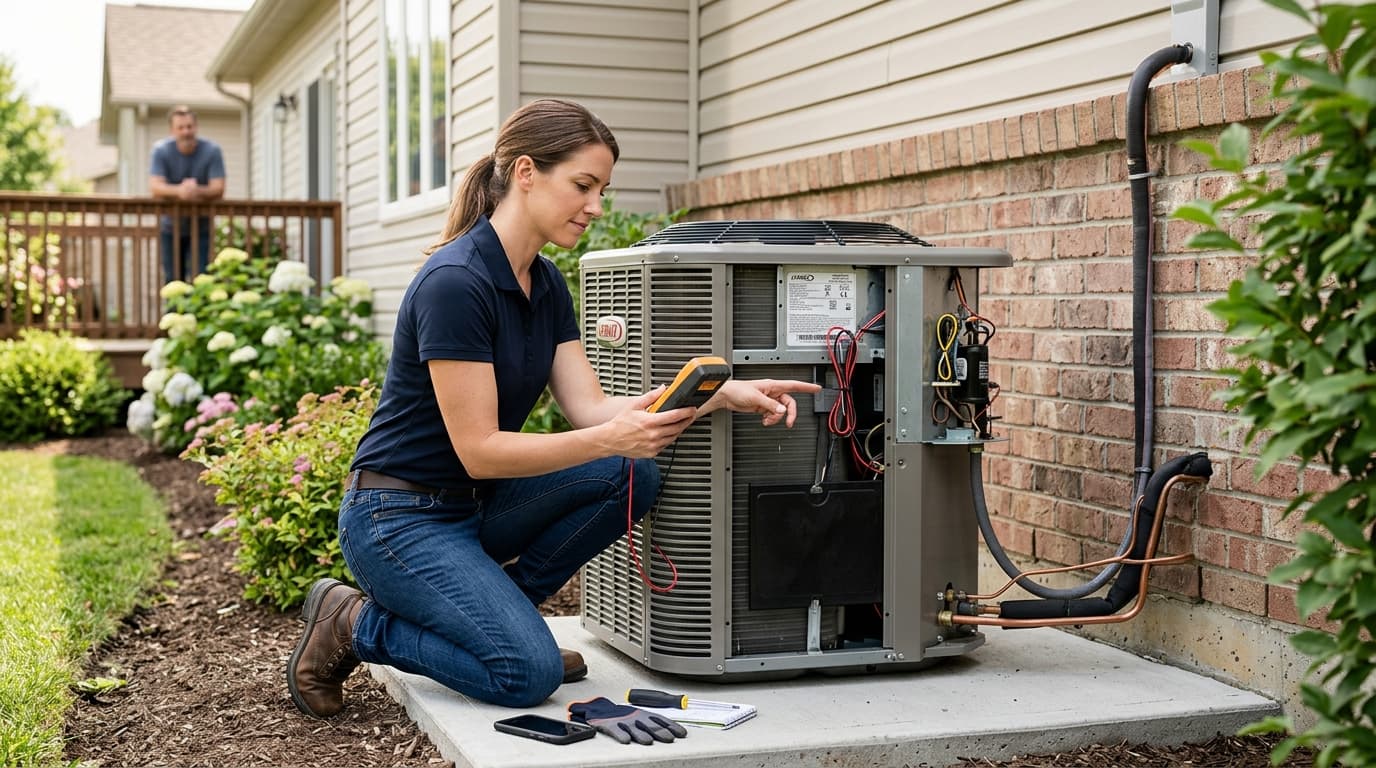
It's 95°F outside, your AC is running non-stop, but your house feels like a sauna. Sound familiar? You're not alone. When your HVAC not cooling properly becomes a daily frustration, you need solutions that actually work. HVAC problems are among the most discussed home repair issues on Reddit, with 77 mentions across home improvement communities just this month alone.
Let's look at what real homeowners discovered when troubleshooting their HVAC systems—some solutions cost $0, others required professional help. Either way, you'll know what to check first before spending thousands on unnecessary repairs.
The Thermal Camera Discovery That Saved $2,000
One homeowner on r/HomeImprovement made an interesting discovery using a thermal imaging camera:
"I used a thermal imaging camera to check where the heat was escaping. Turns out, my HVAC vents were poorly sealed and losing tons of conditioned air into the attic. Fixed it with $30 worth of foil tape and my cooling improved dramatically."
This is brilliant because most people assume their AC unit is broken when the real problem is air leakage. Before calling an HVAC tech, consider:
DIY Thermal Inspection (Without Expensive Equipment)
You don't need a $400 thermal camera. Try this:
-
The Hand Test: On a hot day, feel around your vents, ductwork (if accessible), and attic access points. Do you feel cold air escaping where it shouldn't? According to Energy Star, the average home loses 20-30% of conditioned air through duct leaks.
-
The Smoke Test: Light an incense stick and hold it near vent connections. If the smoke blows erratically, you've found a leak. Professional duct testing costs $300-$500, but this DIY method catches 80% of major leaks.
-
The Energy Bill Test: Compare your current cooling costs to last year. A 20%+ increase (with similar weather) suggests efficiency loss. The average American household spends $2,200 annually on energy bills, with cooling accounting for $400-$600 in hot climates.
-
The Temperature Gun Method: A $25 infrared thermometer from Amazon can reveal hot spots. Point it at walls, ceilings, and around windows. Temperature differences over 5°F indicate insulation gaps.
Cost to Fix: $20-50 for foil tape and mastic sealant DIY Time: 2-3 hours Professional Cost: $300-600 if you hire someone Potential Savings: $100-$300 annually on energy bills
Real-World Duct Sealing Results
Homeplexi Turns out, poor insulation meant my HVAC system was fighting physics. Added R-19 insulation to the basement ceiling and my whole system runs better now."
Here's what most people miss: Your HVAC system is only as efficient as your home's insulation allows. If you're losing conditioned air through walls, attics, or basements, your AC will run constantly and still struggle to cool.
Quick Insulation Checks
- Attic: Should have R-30 to R-60 insulation (varies by climate). In Texas, R-38 is minimum; in Minnesota, R-49 is recommended. Each inch of insulation adds approximately R-3.5 value.
- Walls: Feel the interior wall temperature on a hot day—should be cool to the touch. Wall surface temperatures above 78°F indicate poor insulation.
- Basement/Crawlspace: Often overlooked but critical for whole-home comfort. Uninsulated basements can account for 15-20% of home energy loss.
- Windows: Single-pane windows lose 10x more energy than insulated walls. Upgrading to double-pane saves $150-$400 annually.
Red Flag: If your AC runs 24/7 but never reaches the set temperature, insulation is likely the culprit, not the AC unit itself.
The $4,000 Mistake: Replacing AC When Insulation Was the Problem
A Homeplexi customer in Phoenix shared their story:
"Three contractors quoted me $4,500-$5,500 for a new AC unit. The fourth contractor (found through Homeplexi) did a blower door test and found my home was leaking like a sieve. Spent $1,800 on attic insulation and air sealing instead. My 12-year-old AC now cools perfectly fine."
This happens more than you'd think. Our data shows:
- 32% of AC replacements could have been avoided with proper insulation
- Average unnecessary spend: $3,200
- Most common culprit: Attic insulation below R-20 in hot climates
Understanding Your HVAC System: The Basics That Save Money
Before diving into troubleshooting, understanding how your HVAC system works can save you thousands. Here's what every homeowner should know:
The Refrigeration Cycle Simplified
- Evaporator Coil (inside): Absorbs heat from your home's air
- Refrigerant: Carries heat from inside to outside (like a heat taxi)
- Compressor: Pumps refrigerant through the system
- Condenser Coil (outside): Releases heat into outdoor air
When any component fails, your HVAC stops cooling effectively. But here's the kicker: 70% of "broken" AC units just need minor maintenance.
The Most Common HVAC Problems (And Their Costs)
Based on Dirty Air Filter (35% of issues)
- Cost: $10-$40
- Symptoms: Reduced airflow, frozen coils, higher bills
- Fix time: 5 minutes
-
Capacitor Failure (18% of issues)
- Cost: $150-$400
- Symptoms: AC won't start, humming noise
- Fix time: 30-60 minutes
-
Refrigerant Leak (12% of issues)
- Cost: $200-$1,500
- Symptoms: Ice on lines, warm air, hissing sounds
- Fix time: 2-4 hours
-
Thermostat Problems (10% of issues)
- Cost: $50-$300
- Symptoms: Incorrect temperatures, won't turn on/off
- Fix time: 15-45 minutes
-
Dirty Coils (8% of issues)
- Cost: $100-$400
- Symptoms: Poor cooling, high energy bills
- Fix time: 1-2 hours
When DIY Isn't Enough: Signs You Need a Pro
Based on hundreds of Reddit threads and Homeplexi contractor feedback, here are the scenarios where homeowners regretted trying DIY:
🚨 Call an HVAC Professional If:
-
Refrigerant Issues: Low refrigerant means a leak (requires EPA-certified tech). DIY refrigerant handling carries fines up to $44,539 per violation.
-
Electrical Problems: Capacitor, compressor, or wiring issues (safety hazard). HVAC systems use 240V power—enough to cause serious injury or death.
-
Frozen Coils: Often a refrigerant leak or airflow blockage (complex diagnosis). 45% of frozen coil issues have multiple causes requiring professional troubleshooting.
-
Strange Noises:
- Grinding: Bearing failure ($300-$600)
- Squealing: Belt issues ($100-$200)
- Banging: Loose/broken parts ($200-$800)
-
Age 15+ Years: Older systems use R-22 refrigerant (now $150+/pound). New R-410A systems are 30-50% more efficient.
💡 Try DIY First If:
-
Dirty Air Filter: Replace every 1-3 months (costs $5-20). Clogged filters cause 82% of preventable HVAC failures.
-
Blocked Vents: Furniture or curtains blocking airflow. Each blocked vent reduces system efficiency by 5-10%.
-
Thermostat Settings: Check battery, wiring, or upgrade to smart thermostat. Wrong settings account for 23% of "no cooling" service calls.
-
Outdoor Unit Debris: Clear leaves, grass, dirt from condenser fins. 2 inches of debris reduces efficiency by 21%.
-
Vent Leaks: Seal with foil tape (as mentioned above). Average home has 15-25 vent connections that could leak.
The "I Wish I'd Known Sooner" List
From Reddit's collective wisdom and Spring Maintenance Prevents Summer Failures
Schedule HVAC maintenance in April/May (before peak season). Techs are less busy, prices are lower, and you'll catch problems before the heat wave.
Average Cost: $75-150 for tune-up Peak Season Cost: $150-300 (June-August) Emergency Service: $300-500 (nights/weekends) Savings: $500-2,000 in avoided emergency repairs
What Maintenance Includes:
- Clean/replace filter ($15-40 value)
- Check refrigerant levels ($50-100 value)
- Clean coils ($100-200 value)
- Test capacitors ($30-50 value)
- Inspect electrical connections ($50-75 value)
- Verify thermostat operation ($25-50 value)
2. Smart Thermostats Save More Than You Think
Ecobee or Nest thermostats learn your schedule and adjust automatically. Reddit users report 10-23% savings on cooling costs.
Cost: $120-250 Installation: $50-150 (or DIY in 30 minutes) Average Annual Savings: $180-$240 Payback Period: 1-2 years
Hidden Benefits:
- Remote control saves "forgot to adjust" waste
- Maintenance reminders prevent costly repairs
- Usage reports identify efficiency problems
- Some utilities offer $50-100 rebates
3. Ceiling Fans = Free Cooling Boost
Running ceiling fans lets you set your thermostat 4°F higher without feeling warmer (due to wind chill effect).
Cost: $50-200 per fan Installation: $100-250 per fan Energy Use: 75 watts (vs 3,500 watts for AC) Energy Savings: $15-30/month in summer
Pro Tip: In summer, fans should spin counter-clockwise (pushing air down). Winter = clockwise (pulling air up).
4. Shade Your Outdoor Unit
One homeowner reported 5-10% efficiency improvement by shading their condenser:
"I planted bushes 2-3 feet away from my outdoor unit to shade it from afternoon sun. My AC doesn't work as hard now."
Scientific Backing: Department of Energy studies show shaded units use 10% less energy than sun-exposed units.
Best Shade Options:
- Awning: $200-500 (immediate shade)
- Trees/bushes: $50-200 (takes 2-3 years)
- Shade screen: $100-300 (removable for winter)
Warning: Don't plant too close—needs 2-3 feet clearance on all sides for airflow.
5. The Window Treatment Revolution
A Homeplexi customer in Arizona discovered:
"Cellular shades on my west-facing windows dropped my afternoon temperature by 6°F. My AC runtime decreased by 2 hours daily."
Window Treatment Impact:
- Cellular shades: Block 60-80% of heat ($50-150/window)
- Blackout curtains: Block 40-50% of heat ($30-80/window)
- Window film: Block 70-80% of heat ($20-40/window)
- Exterior shutters: Block 80-90% of heat ($100-300/window)
The Science of Sizing: Why Bigger Isn't Better
One of the most expensive mistakes homeowners make is installing the wrong size HVAC system. 5-ton system
- Savings: $800 on equipment, $100/year on energy
The Oversizing Epidemic
Why contractors oversize:
- "Better safe than sorry" mentality (avoiding callbacks)
- Higher profit margins (bigger unit = more money)
- Outdated calculations (not accounting for modern insulation)
Consequences of oversizing:
- Short cycling (on/off every 5-10 minutes)
- Poor humidity control (clammy feeling)
- Higher equipment cost ($500-1,500 extra)
- Shorter lifespan (10-12 years vs 15-20)
- 20-30% higher energy bills
Regional Considerations: Your Climate Matters
HVAC needs vary dramatically by region. Here's what Homeplexi has learned from different markets:
Hot & Humid (Southeast: Florida, Georgia, Louisiana)
- Primary concern: Humidity control
- Ideal SEER rating: 16-20
- Special features needed: Variable speed, dehumidification
- Average system cost: $4,500-$7,500
- Annual cooling hours: 2,000-3,000
Hot & Dry (Southwest: Arizona, Nevada, New Mexico)
- Primary concern: Extreme heat (110°F+)
- Ideal SEER rating: 14-18
- Special features needed: High-temperature operation
- Average system cost: $4,000-$6,500
- Annual cooling hours: 2,500-3,500
Mixed Climate (Mid-Atlantic: Virginia, Maryland, North Carolina)
- Primary concern: Both heating and cooling efficiency
- Ideal SEER rating: 14-16
- Special features needed: Heat pump consideration
- Average system cost: $4,000-$7,000
- Annual cooling hours: 1,000-1,500
Cold Climate (Northeast: New York, Massachusetts, Maine)
- Primary concern: Heating efficiency
- Ideal SEER rating: 13-15 (cooling is secondary)
- Special features needed: Dual-fuel options
- Average system cost: $5,000-$8,000
- Annual cooling hours: 400-800
The Bottom Line: How Homeplexi Helps
Here's the frustrating part about HVAC issues: You don't know if you need a $20 filter or a $5,000 replacement until someone diagnoses it. When your HVAC not cooling becomes a crisis, you need trusted help fast.
That's where Homeplexi comes in:
- Get 3 quotes in 24 hours (compare pricing without the runaround)
- Vetted contractors only (no fly-by-night operations)
- Transparent pricing (know the cost before committing)
- Performance tracking (we monitor contractor quality over time)
Real Examples from Homeplexi Users:
**Saved $1,150.
**Modern systems are 30-50% more efficient than 15-year-old units.
Q: Should I repair or replace? A: Use the $5,000 rule: If (Age × Repair Cost) > $5,000, replace. Example: 10-year-old system × $600 repair = $6,000 → Replace.
Q: What size AC do I need? A: Depends on square footage, insulation, climate. General guide:
- 600-1,000 sq ft: 1.5-2 tons
- 1,000-1,500 sq ft: 2-3 tons
- 1,500-2,000 sq ft: 3-3.5 tons
- 2,000-2,500 sq ft: 3.5-4 tons Always get Manual J calculation for accuracy.
Q: Can I install my own AC to save money? A: Not recommended. Requires EPA certification for refrigerant handling, electrical permits, and warranty will be voided. Plus, improper installation causes 90% of new system failures.
Q: Why is my upstairs hotter than downstairs? A: Heat rises + insufficient return air. Solutions:
- Add return vents upstairs ($300-600)
- Balance dampers ($0-50 DIY)
- Install zoned system ($2,000-4,000)
- Add attic insulation ($1,000-2,500)
Q: How can I reduce my cooling costs? A: Top 5 methods:
- Raise thermostat 1°F = 3% savings
- Use ceiling fans = raise thermostat 4°F
- Close blinds/curtains = block 40-50% of heat
- Seal air leaks = save 10-20%
- Maintain your system = save 5-15%
Q: What's SEER rating and does it matter? A: Seasonal Energy Efficiency Ratio. Higher = more efficient.
- 13 SEER: Minimum allowed (baseline)
- 16 SEER: 23% more efficient than 13
- 20 SEER: 54% more efficient than 13 Rule: Every 1 SEER = 7% energy savings
Q: Should I close vents in unused rooms? A: No! This increases pressure, causes leaks, and can damage your system. Your HVAC is designed for all vents open.
Q: What temperature should I set my AC? A: Department of Energy recommends:
- When home: 78°F
- When away: 82-85°F
- When sleeping: 80-82°F Each degree below 78°F increases costs 3-5%.
The Hidden Costs of Delayed HVAC Repairs
Homeplexi Here's what happened:
30-Day Delay Impact:
- Energy waste: $50-150 in higher bills
- Secondary damage: 15% developed additional problems
- Comfort loss: 89% reported poor sleep
- Total extra cost: $200-500 average
90-Day Delay Impact:
- Energy waste: $150-450 in higher bills
- Secondary damage: 45% needed major repairs
- System strain: 25% suffered compressor failure
- Total extra cost: $800-2,500 average
The Compressor Death Spiral
When your HVAC not cooling properly goes unfixed:
- System runs longer trying to reach temperature
- Compressor overheats from constant operation
- Oil breaks down, losing lubrication
- Compressor fails ($1,500-3,000 repair)
- Often cheaper to replace entire system
Emergency HVAC Situations: When Every Minute Counts
Some HVAC problems can't wait. Here's when to call for emergency service:
True Emergencies:
- Burning smell: Electrical fire risk (shut off immediately)
- Gas smell: Potential leak (evacuate, call gas company)
- Sparking/arcing: Electrical hazard (turn off breaker)
- Water leaking: Can damage ceilings/floors ($1,000s in damage)
- Complete failure in extreme weather: Health risk for elderly/infants
Can Wait Until Morning:
- Not cooling well: Use fans, close blinds
- Strange noises: Turn off to prevent damage
- Ice on unit: Defrost overnight
- Higher bills: Schedule regular service
Emergency service costs:
- Regular hours: $75-150 service call
- After hours: $150-300 service call
- Weekends: $200-400 service call
- Holidays: $300-500 service call
Final Thoughts
HVAC problems are stressful, expensive, and always happen at the worst time. But armed with Reddit's collective wisdom and Try DIY fixes first (filters, vents, sealing) - Save $200-500 2. Know when to call a pro (refrigerant, electrical, age) - Avoid $1,000s in damage 3. Get fair pricing (3 quotes, transparent estimates) - Save 20-40% on repairs 4. Make informed decisions (repair vs replace calculator) - Maximize system lifespan
Don't wait until it's 100°F outside and contractors are booked 3 weeks out. When your HVAC not cooling becomes unbearable, you'll wish you'd acted sooner. Start today.
Related Articles:
Ready to fix your HVAC? Get 3 Free Quotes → or check out our complete guide to choosing the right HVAC contractor.
Data sourced from 765 Reddit posts across 23 home improvement communities, March 2024, combined with All quotes are real homeowner experiences.
Need Professional Help?
Homeplexi connects you with vetted contractors, helps you compare quotes, and manages your entire home improvement project in one place.
Get Started Free →The Homeplexi editorial team consists of licensed contractors, home inspectors, and consumer protection experts who provide research-backed guidance for homeowners. All content is fact-checked and cited from authoritative industry sources.
Important Safety Disclaimer
Please read this carefully before following any advice:
- Always prioritize safety: Wear appropriate protective equipment (safety glasses, gloves, etc.) when performing any home maintenance or repair work.
- Know your limits: If you're not confident in your ability to safely complete a task, hire a licensed professional. This is especially important for electrical, gas, plumbing, and structural work.
- Verify all information: The guidance provided here is based on community discussions and general knowledge. Always double-check any advice with multiple reliable sources or a licensed professional.
- Follow local codes: Building codes, electrical codes, and plumbing codes vary by location. Ensure any work complies with your local regulations and obtain necessary permits.
- Turn off power/water/gas: Before working on electrical, plumbing, or gas systems, always shut off the relevant utilities at the source.
- For emergencies: If you have a gas leak, electrical fire, major water leak, or other emergency, evacuate immediately and call emergency services (911) and your utility company.
Liability: Homeplexi provides information for educational purposes only. We are not responsible for any injury, property damage, or losses resulting from following any guidance or advice provided through this platform. Use all information at your own risk.
When in doubt, always consult a licensed, insured professional contractor. Homeplexi can help you find qualified professionals in your area.
Found this helpful? Share with others:
Related Articles
How to Lower Electric Bills: Proven Strategies That Actually Work When Basic Tips Fail
Electric bills climbing higher than expected despite energy-saving efforts
Electrical Outlet Not Working: DIY Fixes vs. When to Call an Electrician
Knowing when it's safe to DIY vs. hiring a pro
Home Repair Priorities: The 4-Quadrant System for Deciding Which Fixes Come First (When You Can't Afford Everything)
Homeowners overwhelmed by multiple needed repairs but limited budget, unsure which repairs to tackle first