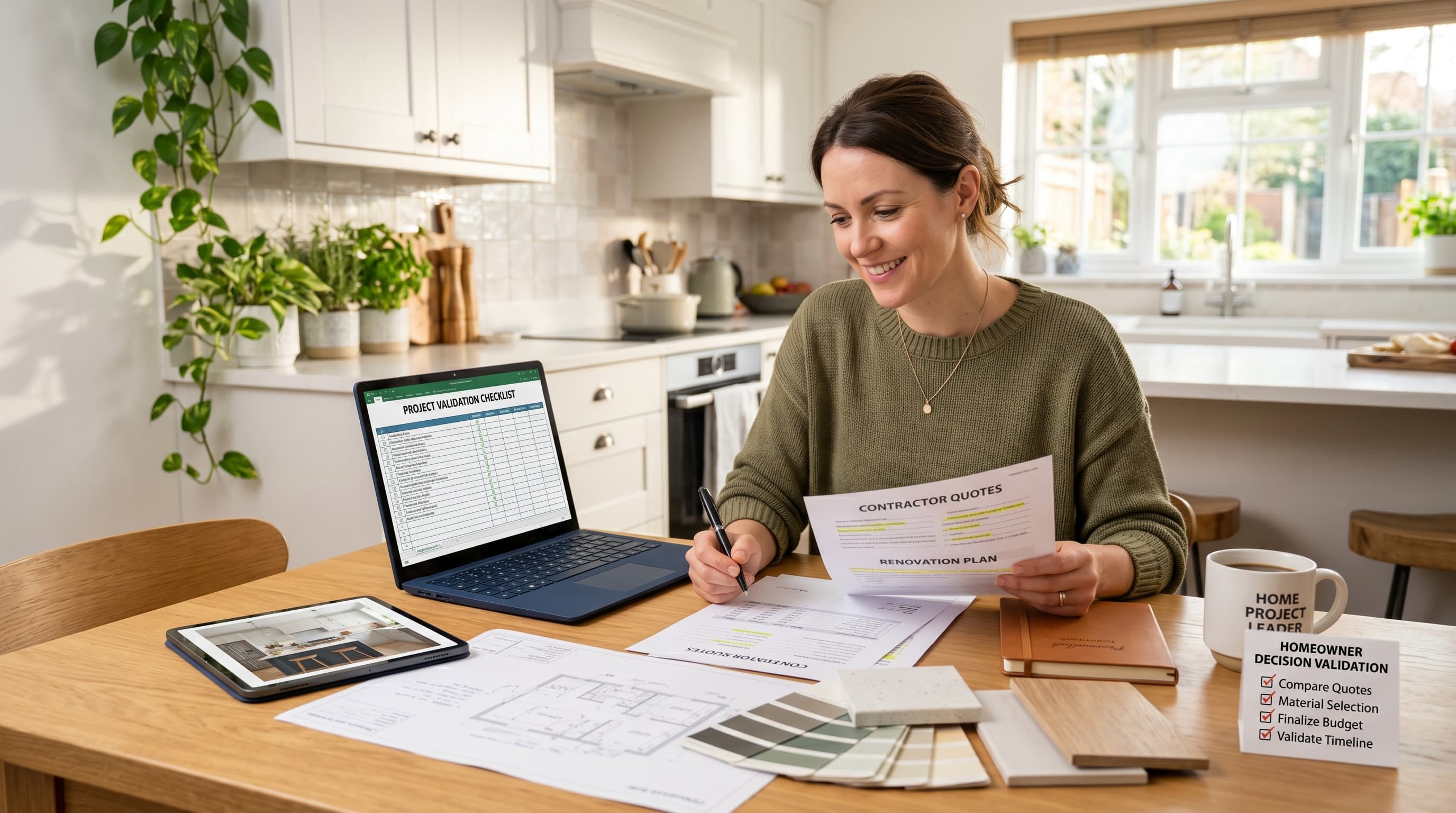
Smart Homeowner Decision Validation Tips: How to Feel Confident About Your Home Improvement Choices
Staring at three different contractor quotes spread across your kitchen table, you feel that familiar knot in your stomach. Should you go with the middle bid? Is the cheapest option too risky? Will you regret spending extra on premium materials? You're not alone—this uncertainty about home improvement decisions keeps millions of homeowners awake at night, second-guessing choices that could impact their largest investment for decades to come.
The truth is, homeowner decision validation doesn't have to feel like rolling dice with your life savings. Smart homeowners use proven strategies to validate their choices before committing, turning anxiety into confidence through systematic evaluation. Whether you're facing a $500 bathroom fixture upgrade or a $50,000 kitchen renovation, the right validation process helps you move forward with clarity instead of crossing your fingers and hoping for the best.
Why Home Improvement Decisions Feel So Overwhelming
The High-Stakes Nature of Home Projects
Unlike buying a shirt you can return or choosing a restaurant for dinner, home improvement decisions carry weight that extends far beyond the initial investment. When Sarah from Portland decided to replace her roof last spring, she wasn't just spending $18,000—she was making a choice that would affect her home's value, her family's safety, and her peace of mind for the next 20-30 years.
This permanence creates what psychologists call "decision paralysis." The bigger the stakes, the harder it becomes to pull the trigger. Add in the complexity of construction terminology, varying contractor opinions, and conflicting online advice, and it's no wonder homeowners feel stuck.
The Information Overload Problem
Today's homeowners have access to more information than ever before, but more information doesn't always mean better decisions. Reddit forums offer conflicting experiences, YouTube tutorials make everything look simple, and manufacturer websites promise miraculous results. Meanwhile, each contractor you consult seems to have a different opinion about the "right" approach.
Mike, a homeowner from Denver, spent three months researching flooring options, reading reviews, and watching installation videos. "I knew everything about LVP versus hardwood versus tile," he recalls, "but I still couldn't decide. I had analysis paralysis from too much conflicting information."
The Trust Deficit with Contractors
Many homeowners struggle with decision validation because they're unsure whether to trust contractor recommendations. Are they suggesting premium materials because it's genuinely better for your situation, or because it increases their profit margin? This skepticism, while sometimes warranted, can make every recommendation feel questionable.
Building Your Decision Validation Framework
Start with Your Non-Negotiables
Effective homeowner decision validation begins with clarity about what matters most to you. Before diving into research or collecting quotes, establish your non-negotiables—the factors that will make or break your satisfaction with the project.
Consider these categories:
- Budget boundaries: Your absolute maximum, not your "preferred" spending limit
- Timeline requirements: Hard deadlines versus flexible preferences
- Quality expectations: Where you're willing to compromise and where you're not
- Lifestyle impacts: How much disruption you can realistically handle
For example, when the Johnson family in Atlanta planned their kitchen remodel, they identified three non-negotiables: staying under $35,000, completing work before their daughter's graduation party in June, and maintaining access to coffee-making facilities throughout construction. These clear parameters made every subsequent decision easier to evaluate.
The Three-Source Validation Rule
Smart homeowners never rely on a single source of information when validating major decisions. The three-source rule requires confirming important information through at least three independent channels before moving forward.
For a deck replacement project, your three sources might be:
- Professional opinion: Licensed contractor assessment
- Peer experience: Neighbors or friends who completed similar projects
- Independent research: Consumer Reports, manufacturer specifications, or building code requirements
This approach helped Tom from Phoenix avoid a costly mistake. His contractor recommended composite decking at $45 per square foot, claiming it was the only material that would withstand Arizona heat. But validation through other sources revealed that properly treated cedar ($28 per square foot) performs equally well in his climate, saving him $4,800 on his 300-square-foot deck.
Create Decision Checkpoints
Rather than trying to validate everything at once, establish decision checkpoints throughout your project planning. These are specific moments when you pause to evaluate your choices before moving to the next phase.
Typical checkpoints include:
- After initial contractor consultations but before requesting formal quotes
- After receiving quotes but before signing contracts
- During material selection but before ordering
- At project milestones during construction
At each checkpoint, ask yourself: "Based on what I know now, would I make the same decision again?" If the answer is no, you have permission to adjust course.
Validating Contractor Selection and Quotes
The Reality Check Method for Quotes
When contractors provide dramatically different quotes for the same project, homeowner decision validation becomes crucial. The reality check method helps you understand whether variations reflect different approaches, quality levels, or potential red flags.
Start by breaking down each quote into categories:
- Labor costs (typically 35-50% of total)
- Materials (usually 40-50% of total)
- Permits and fees (5-10% of total)
- Profit margin (10-20% of total)
If one quote is significantly higher or lower, identify which category creates the difference. A $15,000 bathroom remodel quote that's $5,000 less than others might use builder-grade fixtures instead of mid-range options, or it might indicate a contractor who's desperate for work and cutting corners.
The Reference Validation Process
Checking references seems obvious, but most homeowners do it wrong. Instead of asking, "Were you satisfied with the work?" (which almost always gets a positive response), use these specific homeowner decision validation questions:
- "What would you do differently if you hired this contractor again?"
- "Did the final cost match the original quote, and if not, why?"
- "How did they handle problems that came up during construction?"
- "Would you hire them for a project in your master bedroom or main living area?"
The last question is particularly revealing. Homeowners might tolerate average work in a basement or garage but demand excellence in spaces they see daily.
Validating Through Portfolio Review
Request photos of projects completed 2-3 years ago, not just recent work. This timeline reveals how the contractor's work holds up over time and whether they maintain relationships with past clients (contractors confident in their work aren't afraid to show you older projects).
When reviewing portfolios, look for projects similar to yours in scope, style, and budget range. A contractor who specializes in luxury kitchens might not be the right fit for your budget-conscious bathroom update, regardless of their skill level.
Material and Design Choice Validation
The 10-Year Test for Material Decisions
Before committing to any material choice, apply the 10-year test: "How will I feel about this decision in 10 years?" This homeowner decision validation technique helps separate trendy choices from timeless ones.
Consider granite countertops versus quartz. Granite was the premium choice 15 years ago, but many homeowners now prefer quartz for its consistency and low maintenance. Meanwhile, subway tile has remained popular for over a century. The 10-year test doesn't mean avoiding all trends, but it encourages thoughtful consideration of longevity.
Lifestyle Compatibility Assessment
The most beautiful material choice becomes a poor decision if it doesn't match your lifestyle. Validate material selections by honestly assessing your household's habits and priorities.
Questions to consider:
- Maintenance commitment: Will you actually seal natural stone annually?
- Usage patterns: Do you cook daily or just on weekends?
- Family dynamics: Do you have young children, pets, or frequent guests?
- Cleaning preferences: Do you enjoy detailed maintenance or prefer set-and-forget solutions?
Linda from Seattle learned this lesson the hard way. She chose beautiful white oak floors for their kitchen, but with three kids and two dogs, the floors showed every scratch and required constant attention. "I spent more time worrying about the floors than enjoying them," she admits.
The Sample Living Test
For major material decisions, live with samples in your space for at least a week before committing. Tape paint samples to walls, place flooring samples in different lighting conditions, and observe how materials look throughout the day.
Lighting dramatically affects material appearance. That gorgeous blue-gray paint might look perfect in the store but appear stark and cold in your north-facing bedroom. The sample living test reveals these issues before you've committed to gallons of paint or hundreds of square feet of flooring.
Financial Decision Validation Strategies
The Total Cost of Ownership Analysis
Smart homeowner decision validation goes beyond initial project costs to consider long-term financial implications. A cheaper option that requires replacement in 5 years might cost more than a premium choice lasting 20 years.
Calculate total cost of ownership using this formula: Initial Cost + (Annual Maintenance × Years) + Replacement Cost = Total Cost of Ownership
For example, comparing roof materials:
- Asphalt shingles: $12,000 initial + ($200 annual maintenance × 20 years) + $12,000 replacement = $28,000 over 20 years
- Metal roofing: $22,000 initial + ($50 annual maintenance × 20 years) + $0 replacement = $23,000 over 20 years
This analysis reveals that metal roofing, despite higher upfront costs, provides better long-term value.
The 1% Rule for Home Improvement Budgeting
A useful validation tool for project sizing is the 1% rule: annual home maintenance and improvement costs should roughly equal 1% of your home's value. If your home is worth $400,000, budgeting $4,000 annually for maintenance and improvements keeps you ahead of depreciation.
This doesn't mean spending exactly 1% every year, but rather averaging that amount over time. Some years you might spend $10,000 on a roof replacement, other years just $500 on touch-up painting.
Financing Decision Validation
When projects exceed your cash reserves, validate financing decisions by comparing total costs across different options:
- Home equity loans: Fixed rates, predictable payments, tax-deductible interest
- Personal loans: Faster approval, no collateral risk, typically higher rates
- Contractor financing: Convenient but often expensive
- Credit cards: Quick access but highest interest rates
The right choice depends on your credit score, project timeline, and risk tolerance. For a $25,000 kitchen remodel, a home equity loan at 6% costs $2,750 in interest over 3 years, while contractor financing at 12% costs $5,100—a $2,350 difference.
Timeline and Project Scope Validation
The Seasonal Reality Check
Project timing significantly impacts costs, contractor availability, and your satisfaction with the process. Validate your timeline against seasonal realities in your area and the specific trade requirements.
Spring considerations:
- High contractor demand drives up prices
- Weather delays are common in many regions
- Material delivery schedules may be extended
Summer realities:
- Peak season for exterior work
- Vacation schedules affect contractor availability
- Extreme heat can impact some material installations
Fall opportunities:
- Contractors often offer better pricing to fill schedules
- Weather is typically more predictable
- Holiday deadlines create pressure for completion
Winter challenges:
- Limited options for exterior work in cold climates
- Shorter daylight hours slow progress
- Holiday schedules disrupt normal workflows
Scope Creep Prevention Strategies
One of the most important homeowner decision validation skills is recognizing when project scope begins expanding beyond your original plan. Scope creep happens gradually—a small upgrade here, an additional feature there—until your $20,000 bathroom remodel becomes a $35,000 project.
Prevent scope creep by:
- Writing down your original goals and referring back to them regularly
- Establishing a "scope creep budget" of 10-15% for genuinely necessary additions
- Requiring 48-hour consideration periods before approving any changes
- Calculating the total impact of each addition on timeline and budget
When the Martinez family renovated their master bathroom, they started with plans for a simple refresh: new vanity, toilet, and paint. By week three, they had added heated floors, a rainfall showerhead, and custom tile work. Their validation process caught this scope creep before it spiraled out of control, and they decided to complete the additions in a future phase.
The Disruption Assessment
Validate your timeline by honestly assessing how much disruption your household can handle. Construction is stressful under the best circumstances, but inadequate preparation for the reality of living through a renovation can strain relationships and mental health.
Consider these disruption factors:
- Noise levels and duration during different project phases
- Access limitations to affected areas
- Dust and debris management
- Utility interruptions for electrical, plumbing, or HVAC work
- Storage needs for displaced belongings
A kitchen remodel typically means 4-8 weeks without a functional kitchen. Can your family realistically manage with takeout, a microwave, and a mini-fridge? If not, factor temporary kitchen setup costs into your budget or adjust your timeline to minimize disruption.
Red Flags and Warning Signs to Watch For
Pressure Tactics and Urgency Claims
Legitimate contractors don't use high-pressure sales tactics or create artificial urgency. Be wary of these warning signs during your homeowner decision validation process:
- "Today only" pricing that expires if you don't sign immediately
- Door-to-door solicitation offering to fix problems they "noticed"
- Requests for full payment upfront before work begins
- Lack of proper licensing or insurance documentation
- Verbal estimates only without written documentation
Sarah from Minneapolis nearly fell for a roofing scam after a severe storm. A contractor knocked on her door claiming to have noticed storm damage and offering a "special price" if she signed that day. Her validation process—checking references, verifying insurance, and getting multiple quotes—revealed the "damage" was normal wear and the "special price" was 40% above market rate.
Quality Shortcuts That Cost More Later
Some cost-cutting measures create bigger expenses down the road. Validate contractor suggestions against industry best practices, especially for these commonly compromised areas:
Foundation and structural work:
- Proper permits and inspections are non-negotiable
- Cutting corners on drainage can cause expensive water damage
- Undersized materials may not meet code requirements
Electrical and plumbing systems:
- Code compliance affects safety and home insurability
- Cheap fixtures often fail prematurely
- Improper installation voids manufacturer warranties
Exterior work:
- Weather barriers and flashing prevent costly water intrusion
- Proper ventilation prevents moisture problems
- Quality fasteners and materials withstand weather extremes
Communication Red Flags
Poor communication during the planning phase predicts problems during construction. Validate your contractor choice by paying attention to these communication patterns:
- Delayed responses to questions or concerns
- Vague answers about timeline, materials, or methods
- Reluctance to provide references or portfolio examples
- Pressure to make quick decisions without adequate information
- Dismissive attitude toward your questions or preferences
Good contractors welcome questions and provide detailed explanations. They understand that informed homeowners make better clients and are more likely to be satisfied with the final result.
Creating Your Personal Validation Checklist
Pre-Project Validation Steps
Develop a standardized checklist for validating decisions before any home improvement project begins. This systematic approach ensures you don't skip important validation steps when excitement or pressure mounts.
Essential pre-project validation: □ Budget confirmed with 20% contingency fund □ Timeline realistic for your household's needs □ Contractor fully vetted through references and licensing verification □ Materials selected based on lifestyle compatibility □ Permits identified and application process understood □ Financing arranged if needed □ Disruption plan created for family and pets □ Success criteria defined for project completion
During-Project Validation Points
Even after construction begins, continue validating decisions at key milestones. This ongoing process helps catch problems early when they're easier and cheaper to fix.
Weekly validation questions:
- Is the work progressing according to schedule?
- Are materials and workmanship meeting expectations?
- Are change orders necessary, and if so, why?
- Is communication with the contractor remaining positive and productive?
- Are you still comfortable with the project's total cost and timeline?
Post-Project Validation Review
After project completion, conduct a validation review to improve your decision-making process for future projects. This reflection helps you recognize patterns in your decision-making and identify areas for improvement.
Post-project review questions:
- Which decisions am I most satisfied with, and why?
- What would I do differently knowing what I know now?
- How accurate were my initial budget and timeline estimates?
- Which validation techniques were most helpful?
- What warning signs did I miss or handle well?
Document these insights for future reference. Many homeowners make the same mistakes repeatedly because they don't systematically learn from past experiences.
Building Confidence in Your Decisions
The Gradual Commitment Strategy
For homeowners who struggle with decision anxiety, the gradual commitment strategy builds confidence through smaller, reversible steps before major commitments. Instead of signing a $30,000 contract after one consultation, test your comfort level with smaller interactions.
Start by hiring your potential contractor for a small repair or consultation project. This gives you firsthand experience with their communication style, work quality, and reliability before committing to a major renovation. If the small project goes well, you'll feel more confident moving forward. If it doesn't, you've learned valuable information at minimal cost.
Leveraging Professional Validation
Sometimes the best homeowner decision validation comes from independent professionals who don't benefit from your specific choices. Consider consulting:
- Home inspectors for objective assessments of needed repairs
- Interior designers for space planning and material selection guidance
- Structural engineers for foundation or load-bearing wall questions
- Energy auditors for efficiency upgrade recommendations
These professionals typically charge $200-500 for consultations but can save thousands by helping you avoid costly mistakes or unnecessary work.
The Confidence Building Documentation
Keep detailed records of your validation process, including research notes, contractor communications, and decision rationale. This documentation serves multiple purposes:
- Reduces second-guessing by reminding you why you made specific choices
- Provides reference material for future projects
- Creates accountability for contractors who made specific promises
- Supports warranty claims if problems arise later
When Linda from Portland documented her contractor selection process, she included photos of previous work, reference contact information, and notes from initial consultations. Six months later, when a minor issue arose, she could quickly reference the contractor's specific commitments and resolve the problem professionally.
Conclusion: Moving Forward with Confidence
Effective homeowner decision validation isn't about eliminating all risk—that's impossible in home improvement projects. Instead, it's about making informed decisions based on thorough research, clear priorities, and realistic expectations. The goal is replacing anxiety with confidence, not achieving perfection.
Remember that validation is an ongoing process, not a one-time event. Your needs, budget, and circumstances may change during project planning or execution. The validation techniques outlined here provide a framework for adapting to new information while staying true to your core objectives.
Start implementing these homeowner decision validation tips with your next project, whether it's a simple bathroom update or a whole-house renovation. Begin with the decision framework—clarify your non-negotiables, establish validation checkpoints, and commit to the three-source rule for important information.
Most importantly, trust the validation process. When you've done your research, checked references, and confirmed your decisions through multiple sources, move forward with confidence. Second-guessing validated decisions creates more stress than the original uncertainty.
Your home improvement journey should enhance your life, not consume it with worry. With systematic validation techniques and clear decision-making frameworks, you can transform overwhelming choices into confident actions that improve your home and your peace of mind.
Related Articles:
- How to Find a Reliable Contractor: 7 Red Flags to Watch For
- How to Evaluate Home Improvement Work Quality: A Homeowner's Guide to Realistic Standards and Red Flags
- Essential Questions to Ask Contractors Before Hiring: Your Complete Vetting Guide
- The Complete Home Renovation Cost Estimator Guide: Budget Like a Pro in 2026
Need Professional Help?
Homeplexi connects you with vetted contractors, helps you compare quotes, and manages your entire home improvement project in one place.
Get Started Free →Important Safety Disclaimer
Please read this carefully before following any advice:
- Always prioritize safety: Wear appropriate protective equipment (safety glasses, gloves, etc.) when performing any home maintenance or repair work.
- Know your limits: If you're not confident in your ability to safely complete a task, hire a licensed professional. This is especially important for electrical, gas, plumbing, and structural work.
- Verify all information: The guidance provided here is based on community discussions and general knowledge. Always double-check any advice with multiple reliable sources or a licensed professional.
- Follow local codes: Building codes, electrical codes, and plumbing codes vary by location. Ensure any work complies with your local regulations and obtain necessary permits.
- Turn off power/water/gas: Before working on electrical, plumbing, or gas systems, always shut off the relevant utilities at the source.
- For emergencies: If you have a gas leak, electrical fire, major water leak, or other emergency, evacuate immediately and call emergency services (911) and your utility company.
Liability: Homeplexi provides information for educational purposes only. We are not responsible for any injury, property damage, or losses resulting from following any guidance or advice provided through this platform. Use all information at your own risk.
When in doubt, always consult a licensed, insured professional contractor. Homeplexi can help you find qualified professionals in your area.
Found this helpful? Share with others:
Related Articles
Why Does My Dishwasher Have Standing Water?
Dishwasher not draining properly
The Complete Home Renovation Cost Estimator Guide: Budget Like a Pro in 2026
Uncertain about realistic budgets for major home improvement projects
Property Management Nightmares: How to Coordinate Multiple Contractors
Managing multiple properties and contractors