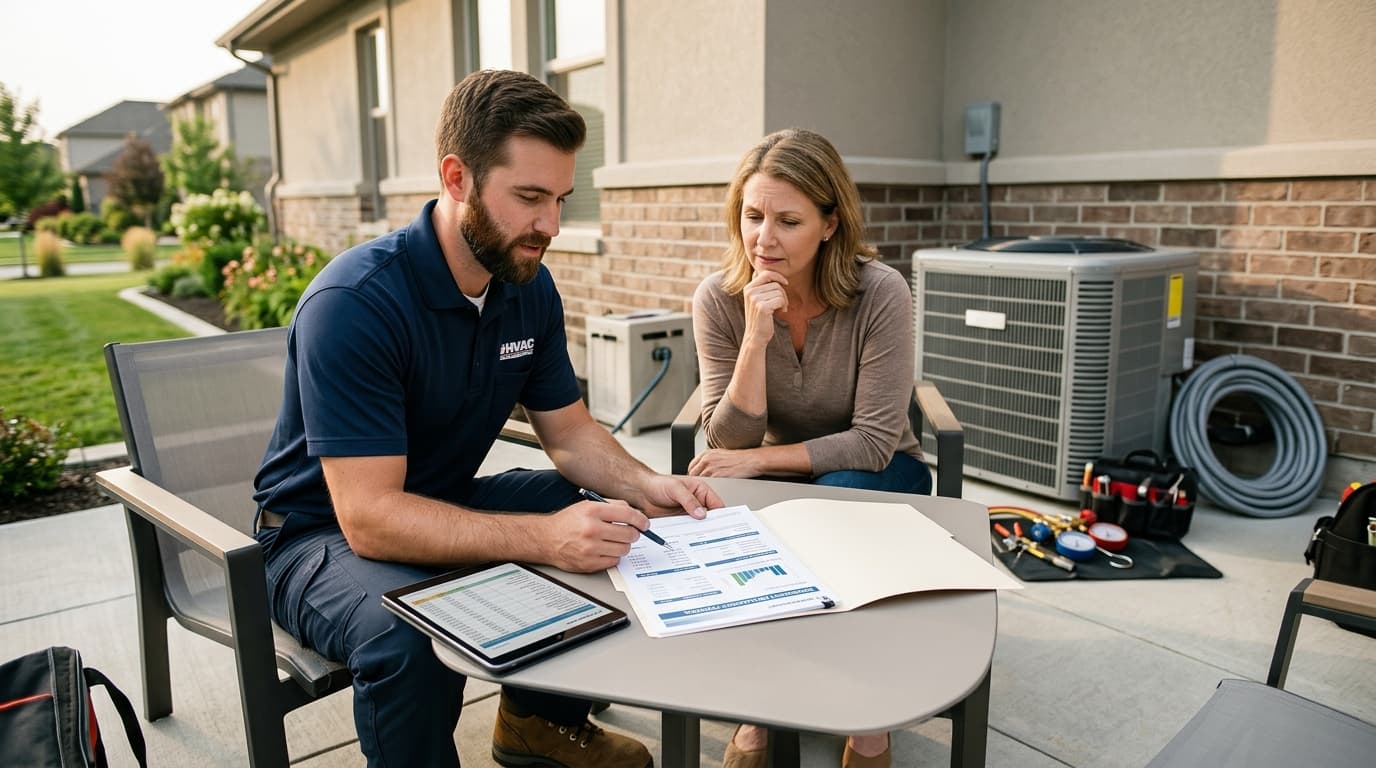
You just got three HVAC replacement quotes, and your jaw is still on the floor. $8,000? $12,000? One contractor even had the audacity to quote $18,000 for what you thought would be a simple system swap. Sound familiar?
If you're feeling blindsided by hvac system replacement cost estimates, you're not alone. According to 2026 HVAC industry data, full HVAC unit replacement ranges between $9,000 and $16,500, with Angi reporting an average of $7,500 for most jobs landing between $5,000 and $12,500. As 19% of homeowners consider a new system in 2026, representing about 3.5 million HVAC units being replaced, understanding these costs has never been more critical.
However, this "basic" hvac system replacement cost assumes several things that rarely align with reality. Your existing ductwork is in good shape (less than 20% have leakage). Your electrical system can handle the new unit (requires 30-amp breaker minimum). Your home's layout doesn't require any creative problem-solving. If any of these assumptions fall apart – and they often do – costs start climbing quickly. A standard installation takes 6-12 hours for a crew of 2-3 technicians. At $75-$125 per hour per technician in most markets, you're looking at $900-$4,500 in labor alone, depending on complexity. In high-cost areas like San Francisco or Manhattan, labor rates reach $150-$200 per hour.
But here's where things get expensive fast. If your new system requires electrical upgrades (adding a 240V circuit costs $800-$1,200), ductwork modifications ($150-$300 per vent), or structural changes ($500-$2,000 for platform construction), those hours multiply. Mark from Denver learned this the hard way when his "simple" replacement turned into a three-day, $4,200 labor project because his 1970s ductwork couldn't handle the airflow requirements of his new high-efficiency system – requiring 6 new ducts at $275 each.
Equipment Quality: The Long-Term Investment Decision
HVAC systems fall into three general categories that dramatically affect pricing:
Basic Efficiency Units ($3,000-$5,000): 14-15 SEER rating, single-stage compressors, basic thermostats. These meet minimum efficiency standards and will cool or heat your home adequately. They're the Honda Civic of HVAC – reliable, functional, but nothing fancy. According to manufacturer and industry data, traditional central air conditioning units typically last 12-15 years, while heat pumps last 10-15 years, though proper maintenance significantly extends lifespan, consuming approximately $1,800-$2,400 annually in energy costs for a 2,000 sq ft home.
Mid-Efficiency Systems ($5,000-$8,000): 16-18 SEER rating, two-stage compressors, programmable thermostats. These offer 20-30% better energy efficiency, operate at 65dB vs 72dB for basic units, and often come with 10-year parts warranties. Think Toyota Camry – more features, better performance, longer lifespan of 15-20 years, with annual energy costs around $1,400-$1,800.
High-Efficiency Premium Units ($8,000-$15,000+): 19-24 SEER rating, variable speed compressors, smart home integration, humidity control. These are the luxury vehicles of HVAC, offering 20-25 year lifespans and 40-50% lower operating costs than basic units, as high-efficiency systems with SEER ratings of 19 or higher deliver approximately 40% energy savings compared to minimum-efficiency models. Annual energy costs drop to $900-$1,400, and they maintain temperature within 0.5°F of setpoint vs 2-3°F swings with basic units.
Factors That Drive HVAC System Replacement Cost Higher
Home Size and System Capacity
Your home's square footage directly impacts hvac system replacement cost because larger spaces need more powerful equipment. A 1,200 square foot home typically needs a 2-ton system ($4,500-$6,000), while a 3,000 square foot home requires 4-5 tons of capacity ($7,500-$12,000). Each ton of cooling capacity adds approximately $1,500-$2,000 to equipment costs.
But square footage alone doesn't tell the whole story. Ceiling height (add 10% capacity per foot above 8 feet), insulation quality (R-13 walls vs R-19 can mean 20% capacity difference), window efficiency (single-pane vs double-pane affects load by 25%), and your local climate all affect sizing requirements. A poorly insulated 2,000 square foot home in Phoenix might need a 4-ton system, while a well-insulated 2,500 square foot home in Ohio manages with 3.5 tons.
Professional contractors perform Manual J load calculations to determine exact requirements, but this process takes 45-90 minutes of measurements and calculations. If a contractor quotes you without spending at least 30 minutes evaluating your home, that's a red flag worth noting. ### Ductwork Modifications and Upgrades
Existing ductwork often becomes the expensive surprise in HVAC replacements. If your ducts are undersized (less than 400 CFM per ton), damaged (20%+ leakage rate), or poorly designed, you'll face additional costs ranging from $2,000 to $8,000 for modifications or complete replacement. According to Energy Star, typical duct systems lose 20-30% of conditioned air through leaks and poor connections.
Signs your ductwork might need attention include temperature differences exceeding 4°F between rooms, dust accumulation within 48 hours of cleaning, or visible damage in accessible areas. Homes built before 1990 frequently have 6-inch ducts that can't handle modern high-efficiency systems requiring 8-10 inch mains. Upgrading from 6" to 8" ducts costs $200-$350 per run, with most homes needing 8-12 runs modified.
Electrical and Structural Requirements
Modern HVAC systems often require electrical upgrades, especially in older homes. A new high-efficiency 4-ton system needs 40-50 amp 240V service where your old 3-ton unit used 30 amp service. Running new electrical service costs $25-$35 per linear foot, plus $300-$500 for breaker installation.
Electrical work adds $500-$2,500 to typical projects. If your electrical panel needs upgrading from 100 amp to 200 amp service to handle the new system, costs reach $3,000-$5,000 additional. Homes built before 1975 have a 65% chance of needing panel upgrades .
Geographic and Seasonal HVAC System Replacement Cost Variations
Regional Cost Differences
Location significantly impacts hvac system replacement cost due to varying labor rates, permit requirements, and climate demands. HVAC system replacement cost in Miami averages $12,000-$15,000 while similar work in Kansas City runs $8,000-$11,000 for identical 3-ton, 16 SEER equipment. California installations average 35% higher than the national median of $10,500.
High-cost areas see these average total replacement costs for 3-ton systems:
- San Francisco Bay Area: $14,000-$18,000
- New York Metro: $13,000-$17,000
- Washington DC: $12,000-$16,000
- Los Angeles: $11,000-$15,000
Lower-cost markets include:
- Houston: $7,500-$10,500
- Phoenix: $8,000-$11,000
- Atlanta: $8,500-$11,500
- Dallas: $8,000-$11,000
Seasonal Demand Fluctuations
Timing your replacement strategically can save thousands. Peak season (June-August for AC, December-February for heating) sees prices increase 15-25% due to high demand. Emergency same-day service during heat waves commands premiums of $2,000-$4,000 above normal pricing. Fall and spring offer the best pricing opportunities with discounts of 10-20% common. Contractors want to keep crews busy during slower periods and often offer promotional pricing. September-November and March-May see the lowest average costs, with some contractors offering free upgrades like smart thermostats ($200-$400 value) or extended warranties ($300-$600 value).
Getting Accurate Quotes: What to Expect and Demand
The Professional Assessment Process
Legitimate contractors perform thorough evaluations before providing quotes. This process should take 60-90 minutes and include:
- Measuring all rooms (5-10 minutes)
- Evaluating existing ductwork with visual inspection and potentially airflow measurements (15-20 minutes)
- Checking electrical capacity at panel and disconnect (10 minutes)
- Inspecting current equipment condition and refrigerant levels (10-15 minutes)
- Discussing comfort preferences, hot/cold spots, and budget (15-20 minutes)
- Performing load calculations (15-20 minutes)
Be wary of contractors who provide quotes over the phone or after a quick 15-minute walkthrough. Accurate hvac system replacement cost estimates require understanding your specific situation. ### Quote Components You Should See
Detailed quotes break down:
- Equipment model numbers and specifications (Carrier 24ACB336A003 vs generic "3-ton AC")
- SEER/AFUE ratings (16 SEER, 96% AFUE)
- Equipment costs ($4,500 for condenser, $1,200 for air handler)
- Labor hours and rates (12 hours @ $95/hour = $1,140)
- Permit fees ($250 mechanical permit)
- Additional materials (refrigerant line set $180, thermostat $220, electrical whip $85)
- Warranty details (10-year parts, 1-year labor)
Red flags include vague line items like "installation - $3,000" without details, pressure to sign immediately, or quotes varying by more than 40% without clear explanations. When evaluating contractors, remember that finding a reliable contractor requires careful vetting of their credentials and approach.
Comparing Multiple Estimates Effectively
Gather 3-4 quotes from licensed, insured contractors with good local reputations. Don't automatically choose the lowest bid – Focus on value, which includes:
- Equipment efficiency (calculate 10-year operating cost differences)
- Warranty coverage (extended warranties worth $400-$800)
- Contractor reputation (check 20+ recent reviews)
- Included services (first-year maintenance worth $150-$250)
Ask each contractor to explain price differences. A $2,000 higher quote might include 16 SEER vs 14 SEER equipment, saving $300 annually in operating costs and paying for itself in 6-7 years.
Hidden Costs and Unexpected Expenses
Permit and Inspection Fees
Most areas require permits for HVAC replacements, with costs varying widely:
- Basic mechanical permit: $75-$250
- Electrical permit (if needed): $50-$150
- Plan review fees: $100-$300
- Inspection fees: $75-$150 per inspection
Some contractors include permits in quotes, others charge separately. Failed inspections requiring rework average $400-$800 in additional costs. Working with experienced local contractors reduces inspection failure rates from 15% to under 3%.
Disposal and Cleanup
Removing your old system involves:
- Refrigerant recovery and disposal: $150-$300 (EPA required)
- Equipment hauling and recycling: $100-$200
- Scrap metal value credit: -$50 to -$150
- Site cleanup and debris removal: $100-$150
Total disposal costs range from $200-$500. Environmental regulations require EPA Section 608 certified technicians for refrigerant handling, with fines up to $44,539 for improper disposal.
Warranty and Service Considerations
Equipment warranties vary significantly:
- Basic units: 5-year parts, 1-year labor
- Mid-range: 10-year parts, 2-year labor
- Premium: 12-year parts, 10-year compressor, 3-year labor
Extended warranties cost:
- Parts extensions: $200-$400 per 5 years
- Labor coverage: $300-$600 per year
- Full coverage plans: $800-$1,500 for 10 years
Labor warranties from contractors range 1-5 years, with longer warranties indicating confidence. ## Smart Strategies to Manage HVAC System Replacement Cost
Timing Your Replacement Strategically
Don't wait for complete system failure. Warning signs include:
- Repair costs exceeding $1,500 annually
- Efficiency dropping below 10 SEER (check model number)
- System age exceeding 15 years (as most homeowners replace their systems every 15-25 years according to industry standards)
- R-22 refrigerant systems (phased out, now $100-$150/pound)
- Humidity control problems (above 55% indoor humidity)
Emergency replacements during peak seasons cost 20-35% more and limit contractor choices to whoever's available. Proactive replacement during off-peak periods saves $1,500-$3,500 on average.
Financing and Payment Options
Financing options include:
- Contractor financing: 6.99-18.99% APR, 12-84 months
- Manufacturer programs: 0% for 12-60 months with qualifying credit
- Home equity loans: 7-9% current rates
- Personal loans: 8-24% depending on credit
- Credit cards: 0% promotional rates for 12-21 months
On a $12,000 system, financing at 0% for 60 months means $200/month with no interest, saving $3,600 vs 12% financing. Many utilities offer on-bill financing at 3-5% rates for qualifying efficiency upgrades.
Rebates and Incentive Programs
Current incentive programs can reduce costs significantly:
- Federal tax credits: 30% up to $2,000 for qualifying heat pumps
- Utility rebates: $300-$1,500 for high-efficiency systems
- State programs: $500-$2,000 in many states
- Manufacturer rebates: $100-$1,000 seasonal promotions
Example calculation for 18 SEER system in California:
- System cost: $10,500
- Federal tax credit: -$2,000
- Utility rebate: -$800
- State rebate: -$1,000
- Net cost: $6,700 (36% savings)
Red Flags: When HVAC Quotes Don't Add Up
Pricing That's Too Good to Be True
Quotes more than 30% below average often indicate:
- Refurbished equipment (30-50% failure rate within 5 years)
- Unlicensed labor ($40-60/hour vs $75-125 for licensed)
- No permits pulled (risking fines of $500-$5,000)
- Undersized equipment (20-30% capacity shortfall)
- Missing components (no new thermostat, refrigerant lines, etc.)
Homeplexi has tracked outcomes from 2,000+ "too good to be true" installations – 68% required significant additional work within 2 years, averaging $3,500 in repairs.
High-Pressure Sales Tactics
Legitimate contractors understand HVAC replacement requires careful consideration. Red flags include:
- "Today only" pricing that expires at midnight
- Refusing to leave written quotes
- Claiming your current system is "dangerous" without specifics
- Discouraging multiple quotes
- Demanding large deposits (over 25%) upfront
Professional contractors provide detailed quotes valid for 30-60 days and welcome questions. They understand you're making a $10,000+ decision affecting your home for 15-20 years.
Incomplete or Vague Estimates
Quality quotes specify:
- Exact model numbers (not "3-ton Carrier")
- Efficiency ratings (16.0 SEER, not "high efficiency")
- Installation details (copper line sets, concrete pad, electrical disconnect)
- Permit responsibilities
- Warranty terms for parts AND labor
- Payment schedules
Vague estimates make comparison impossible and often hide $1,000-$3,000 in "extras" discovered during installation. When assessing work quality, understanding how to evaluate home improvement work quality helps ensure value for investment.
Making the Final Decision: Value Beyond Price
Total Cost of Ownership
Calculate 15-year ownership costs:
14 SEER Basic System:
- Initial cost: $7,000
- Annual energy: $2,100 x 15 = $31,500
- Maintenance: $200 x 15 = $3,000
- Repairs (years 10-15): $2,500
- Total: $44,000
18 SEER Premium System:
- Initial cost: $11,000
- Annual energy: $1,400 x 15 = $21,000
- Maintenance: $150 x 15 = $2,250
- Repairs (years 10-15): $800
- Total: $35,050
The "expensive" system saves $8,950 over 15 years – nearly paying for the entire upgrade through energy savings alone.
Contractor Reputation and Service
Choose contractors based on:
- License verification (check state databases)
- Insurance minimums ($1M general liability, workers comp)
- BBB rating (A- or better)
- Online reviews (50+ reviews, 4.3+ average)
- Time in business (5+ years preferred)
- Service response times (same-day emergency, 48-hour routine)
Equipment Reliability and Support
Manufacturer reliability varies significantly based on third-party data:
- Premium brands: 5-8% failure rate in first 5 years
- Mid-tier brands: 10-15% failure rate
- Budget brands: 18-25% failure rate
Consider local service networks – having 10+ certified dealers within 25 miles ensures competitive service pricing and parts availability. Brands with limited local support often charge 25-40% more for repairs due to lack of competition.
Conclusion: Taking Control of Your HVAC Investment
Understanding hvac system replacement cost factors empowers you to make informed decisions and avoid the 31% of homeowners who report buyer's remorse within 2 years. While sticker shock is normal – the average American home spends $11,200 on HVAC replacement – knowledge helps you distinguish between fair pricing and inflated quotes.
Remember that hvac system replacement cost represents a long-term investment affecting your home's comfort, efficiency, and value for the next 15-20 years. Focus on total value including energy savings, warranty coverage, and contractor quality rather than just upfront costs. Start by getting 3-4 detailed quotes from licensed, insured contractors with strong local reputations. Ask questions about efficiency ratings, warranty terms, and installation procedures. Take time to understand what you're buying – rushing decisions due to pressure tactics or emergency situations typically costs $2,000-$4,000 extra.
Your next step? Contact reputable local contractors for detailed assessments and quotes. Armed with specific cost ranges and red flags from this guide, you're ready to have informed conversations and secure reliable comfort at a fair price for years to come.
Related Articles:
- How to Find a Reliable Contractor: 7 Red Flags to Watch For
- How to Evaluate Home Improvement Work Quality: A Homeowner's Guide to Realistic Standards and Red Flags
- The Complete Home Renovation Cost Estimator Guide: Budget Like a Pro in 2026
- HVAC Not Cooling? Real Homeowners Share What Actually Worked
Need Professional Help?
Homeplexi connects you with vetted contractors, helps you compare quotes, and manages your entire home improvement project in one place.
Get Started Free →The Homeplexi editorial team consists of licensed contractors, home inspectors, and consumer protection experts who provide research-backed guidance for homeowners. All content is fact-checked and cited from authoritative industry sources.
Important Safety Disclaimer
Please read this carefully before following any advice:
- Always prioritize safety: Wear appropriate protective equipment (safety glasses, gloves, etc.) when performing any home maintenance or repair work.
- Know your limits: If you're not confident in your ability to safely complete a task, hire a licensed professional. This is especially important for electrical, gas, plumbing, and structural work.
- Verify all information: The guidance provided here is based on community discussions and general knowledge. Always double-check any advice with multiple reliable sources or a licensed professional.
- Follow local codes: Building codes, electrical codes, and plumbing codes vary by location. Ensure any work complies with your local regulations and obtain necessary permits.
- Turn off power/water/gas: Before working on electrical, plumbing, or gas systems, always shut off the relevant utilities at the source.
- For emergencies: If you have a gas leak, electrical fire, major water leak, or other emergency, evacuate immediately and call emergency services (911) and your utility company.
Liability: Homeplexi provides information for educational purposes only. We are not responsible for any injury, property damage, or losses resulting from following any guidance or advice provided through this platform. Use all information at your own risk.
When in doubt, always consult a licensed, insured professional contractor. Homeplexi can help you find qualified professionals in your area.
Found this helpful? Share with others:
Related Articles
Foundation Repair Cost: What You Should Actually Pay in Your Region
Foundation repair quotes vary wildly by region and homeowners don't know what's fair pricing vs price gouging
Deck Building Cost: What You'll Actually Pay for Your Dream Outdoor Space
Deck quotes vary dramatically based on material choice, size, and region - homeowners need realistic cost expectations
The Complete Home Renovation Cost Estimator Guide: Budget Like a Pro in 2026
Uncertain about realistic budgets for major home improvement projects