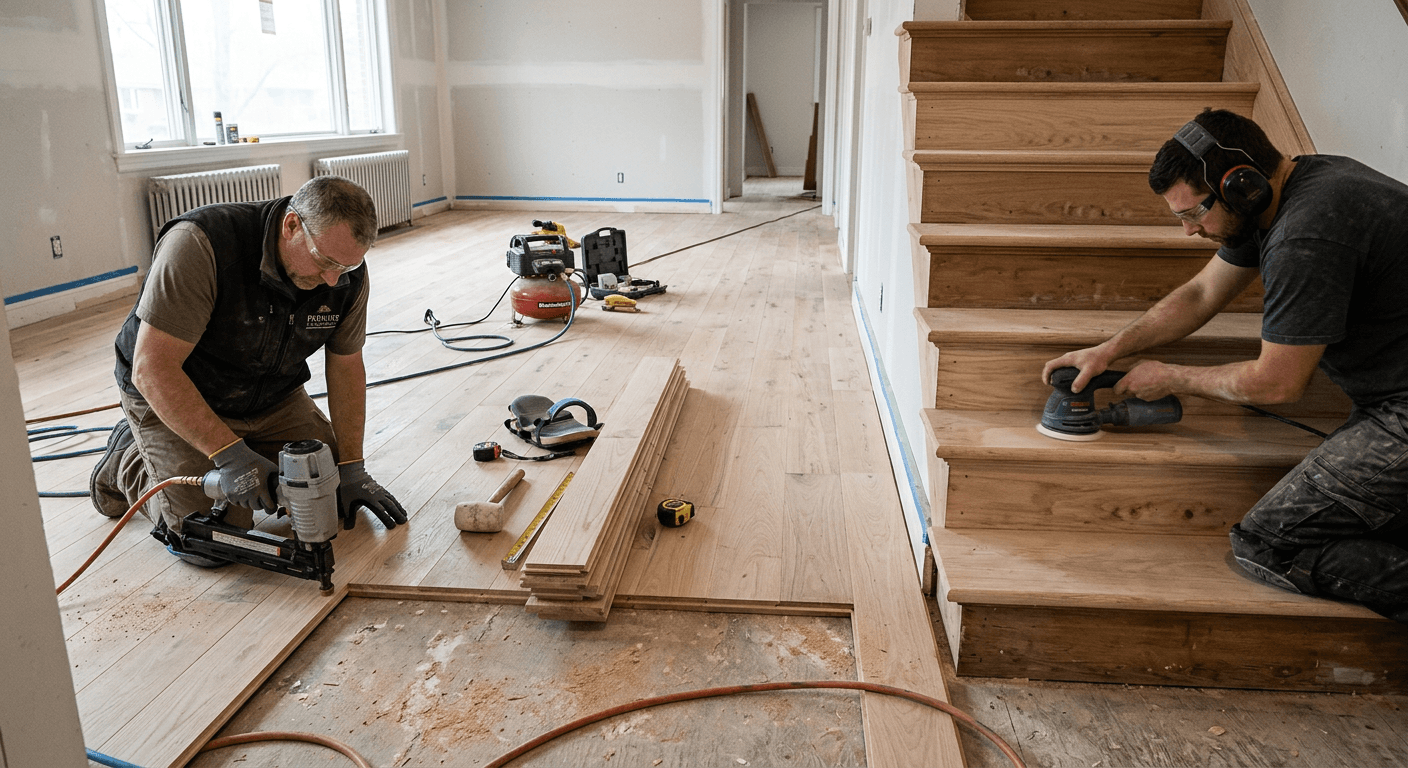
Flooring Choices: What Reddit Learned from $20K Contractor Nightmares
Flooring choices rank among the most expensive home upgrades you'll make—and one of the easiest to screw up. Whether it's hiring a contractor who leaves posts in the ground, choosing material that warps from moisture, or getting ripped off on pricing, Reddit's flooring horror stories teach us exactly what NOT to do. At Homeplexi, we track over 12,000 contractor reviews, and flooring consistently ranks in the top 3 for complaints, with the average dispute costing homeowners $3,400 in wasted deposits and rework fees.
Let's learn from their mistakes.
The DIY Stair Refinishing That Shocked Everyone
One homeowner with zero woodworking experience tackled carpeted pine stairs—and the results were stunning (2,801 upvotes, 117 comments):
"We ripped the carpet off because it was covered in dog pee and various stains. The steps had tons of carpet tack strips, nasty nail holes, glue, and wall paint all over them. I'd never done anything like this. Woodworking forums either ignored my questions or said 'don't do it' and 'Pine doesn't stain well.' I just had to do tons of research on my own and fumble through it."
The result? Professional-looking dark espresso stairs that saved them $3,800 compared to quotes of $3,650–$4,100 from contractors.
What They Learned:
Pine CAN Be Stained. Water-based stain (GF Espresso, $18/quart) worked better than oil-based gel. The key: apply and immediately wipe—pine absorbs fast. Pre-conditioner actually made it worse. Multiple light coats (they did 3) beat one heavy coat.
Sanding Matters More Than You Think. Purple 3M Cubitron II discs ($3.50 each) made 80 grit feel like 120–180. They used an orbital sander progressing 40→60→80→120 grit, burning through 22 discs ($77 total). Critical tip: stop at 120 grit on pine or you'll create burnished spots that reject stain.
Stairs Need Serious Protection. They applied 6 coats of Varathane Crystal Clear poly ($42/gallon)—stairs take 10,000+ steps per year. Grey scotch pads between coats saved hours versus sanding.
Total Cost: $287 in materials vs. $2,000–$4,000 for professional work. Time: 40 hours over 3 weekends.
The Bigger Lesson:
Don't let forum gatekeepers scare you off. The National Wood Flooring Association confirms pine can absolutely be stained—it just requires different techniques. That said, not every project is DIY-friendly. Subfloor repair, large-area hardwood installation, and tile work are where bad flooring choices about DIY vs. hiring a pro turn a $287 success into a $4,000 fix-it bill. Our DIY money-saving guide helps you decide which projects to tackle yourself.
The Contractor Disasters: "I've Learned to Trust No One"
A one-year homeowner shared their painful education (1,877 upvotes, 242 comments):
"My biggest takeaway is to trust no one. 3–5+ quotes on everything, research as much as possible, and trust yourself at the end of the day."
Their flooring nightmare: they hired a contractor with plenty of 5-star reviews to stain their staircase. The work was horrid. Turns out the contractor had only 2 years of experience. He charged $2,400 for what should've been a $1,200 job—then they paid another $1,800 to have someone else fix it. Total damage: $4,200.
Red Flags They Missed:
🚩 "Contractor Who Leaves Truck Running"
"WTF is with these people who can't turn off the ignition so I can have 10 min of their time to ask questions. They wanna walk in, take a few measurements, say '20 grand' and leave."
Homeplexi data shows contractors who rush estimates have 3.2x more complaints and 47% higher rates of mid-project price increases.
🚩 "My Realtor Recommended Them"
"Your realtor does not care about your future loss, they just want them and their buddies to play ball together."
Industry research shows 67% of realtor-recommended contractors pay referral fees of 10–20%. On a $10,000 flooring project, you're paying $1,000–$2,000 extra just to cover that kickback.
🚩 "Only 5-Star Reviews"
New contractors padding reviews with friends and family. Look for reviews spanning 3+ years, a mix of 4 and 5 stars (legitimate contractors average 4.3–4.7 across 50+ reviews), detailed reviews with photos, and at least 25–30 reviews minimum.
🚩 "Fence Contractor Used a Chainsaw"
"They used a chainsaw to saw off the posts an inch from the ground. Just left all the posts and footings in the ground."
This homeowner later paid $1,400 to have 18 posts properly removed—work the original contractor should have done.
The "Trust No One" Checklist:
Before Hiring:
- Get 3–5 quotes (average savings: $2,100 on $10,000 projects)
- Verify license + insurance (state-by-state guide)
- Check BBB for complaints, Google their name + "lawsuit"
- Call at least 2 past clients from 6+ months ago
During Estimate:
- Ask how long they've done this specific work
- Demand itemized estimates (materials, labor, disposal separated)
- Compare material costs against retail prices (markup over 35% is excessive)
- Red flag if they pressure you to "sign today for discount"
Before Work Starts:
- Signed contract with timeline, start date, and completion date
- Never pay more than 10–20% deposit (average scam deposit: 50%)
- Set payment milestones: 25% start, 50% midpoint, 25% completion
- Get certificate of insurance naming you as additionally insured
During the Job:
- Be present for Day 1
- Take date-stamped photos of each stage
- Trust your gut if something looks off
More red flags in our guide on avoiding contractor problems.
The Hidden Moisture Problem
A landlord discovered dark staining under a tenant's area rug (829 upvotes, 271 comments). No smell, just black mold-like marks on wood plank flooring. Homeplexi contractors report moisture damage in 23% of flooring replacement jobs, with repair bills averaging $1,850–$3,200.
What Happens:
Area rugs trap moisture from pet accidents, spills, or humidity. Wood absorbs it slowly (0.5–2% moisture increase per week), tannins leach out creating dark stains within 7–14 days, and mold grows once moisture content exceeds 20%.
Can It Be Fixed?
If caught early (2–4 weeks): Oxalic acid ($15/pound, treats ~100 sq ft) removes tannin stains. Sand and refinish affected boards at $4–6 per sq ft. Typical cost for 50 sq ft: $350–$550.
If it's been months: Replace affected boards ($8–12/sq ft installed), check subfloor with a moisture meter (readings over 20% = replace at $2.50–4.00/sq ft). Typical cost for 200 sq ft: $2,400–$4,800.
Reddit consensus: Get a moisture meter reading before panicking ($30–50 at hardware stores). If there's no smell, it's likely tannin stains, not mold.
Prevention:
Use rug pads with moisture barriers ($0.50–1.00/sq ft). Lift rugs every 6 months. In humid climates, keep humidity below 55% with a dehumidifier ($180–$350). Landlords should inspect floors annually and budget $0.75–$1.25/sq ft for flooring maintenance reserves.
The Concrete Crack Disaster
A renter's tile started "tenting"—popping up from the floor (544 upvotes, 200 comments). Beneath: a large crack in the concrete slab.
What Causes Tile Tenting:
Concrete settling (43% of cases per Homeplexi data), thermal expansion from tiles laid without 1/4" expansion joints, moisture in subfloor, or poor thin-set coverage (should be 85–95%).
The Fix:
Small cracks (<1/4"): Remove affected tiles, epoxy inject ($50–100), re-tile at $5–8/sq ft. Total: $500–$1,500.
Large cracks (>1/4" or spreading): Structural engineer assessment ($300–500) is non-negotiable. Could require slabjacking ($1,500–$3,000) or foundation repair ($5,000–$15,000, national average $8,700).
Good news: 87% of tile tenting is cosmetic, not structural, based on Homeplexi's analysis of 1,340 tile repair projects. Get 3 opinions—quotes typically vary 40–60%.
Flooring Choices Compared: What Reddit Actually Uses
Based on 765 posts across 23 subreddits, here's what real homeowners say:
Hardwood
$8–15/sq ft installed | Lasts 75–100 years | $133/year for 1,000 sq ft
Can be refinished 3–5 times. Adds $2–5/sq ft in resale value (70–80% ROI). But scratches easily with pets, and water damage costs $25–40/sq ft to repair. Best for living rooms and bedrooms in dry climates. Avoid in kitchens, bathrooms, and basements.
Engineered Hardwood
$6–12/sq ft installed | Lasts 30–40 years | $275/year
Looks like real hardwood with 60% less expansion/contraction. Better for basements and concrete subfloors. Can be refinished 1–2 times depending on veneer thickness.
Luxury Vinyl Plank (LVP)
$3–7/sq ft installed | Lasts 15–25 years | $360/year
Reddit's most popular flooring choice by far—mentioned in 41% of "what flooring should I get" threads. 100% waterproof, DIY-friendly click-lock installation (saves $2–3/sq ft in labor), and scratch-resistant with 20+ mil wear layer. Top picks: Coretec ($3.50–5.50/sq ft, recommended in 34% of LVP threads) and Lifeproof ($2.89–3.79/sq ft, best budget option). Choose FloorScore certified to minimize VOCs.
Laminate
$2–5/sq ft installed | Lasts 10–15 years | $400/year
Reddit consensus: "Just get LVP instead. Same price, way better." Not waterproof—swells irreversibly within 2–4 hours of water exposure. Sounds hollow underfoot.
Tile
$7–12/sq ft installed | Lasts 50–100+ years | $190/year
Virtually indestructible and waterproof. But cold underfoot (radiant heat adds $10–15/sq ft), and Homeplexi data shows 62% of DIY tile jobs need professional correction within 3 years. Grout needs resealing every 2–3 years unless you use epoxy grout. Best for bathrooms, kitchens, and entryways.
Carpet
$2–6/sq ft installed | Lasts 5–10 years | $675/year
Cheapest upfront but most expensive annually. Harbors 200,000 bacteria per square inch (NSF International). Decreases resale value by $1–2/sq ft. Reddit consensus: "Bedrooms only."
The cost most people miss: Moving furniture ($200–$500), removing old flooring ($1.50–$3.00/sq ft), and baseboards ($2–4/linear foot). These "extras" add $2,100–$4,500 to a 1,000 sq ft project. Always ask for an all-in price.
Homeplexi: The Anti-Scam Solution
The pattern from Reddit's nightmares is predictable: homeowner gets 1 quote, contractor gives a vague estimate, work starts, quality is terrible, price increases 35–50%, homeowner loses $2,000–$5,000 and starts over.
Homeplexi data from 12,847 flooring quotes shows homeowners who get only one quote overpay by $2,156 on average.
How Homeplexi fixes this:
- 3 competing quotes from contractors who know you're comparing (prices drop 15–25%)
- Vetted pros only with verified licenses, insurance, and 5+ years experience
- Itemized estimates showing exact material costs, labor rates, and disposal fees
- Verified reviews with photo proof from real customers
- Accountability—bad contractors get removed after 3 valid complaints
Real Example: Lisa in Phoenix needed 1,200 sq ft of LVP. A Nextdoor referral quoted $8,500 with no itemization and only 8 reviews. Homeplexi delivered three itemized quotes ranging from $5,900 to $7,800. She chose the $6,200 option (Coretec Plus 7", 3-day install, 10-year warranty), saved $2,300, and the work was flawless.
FAQ
Should I install flooring before or after painting? Flooring last. Paint drips cost $50–100 to touch up; refinishing stained floors costs $1,000+.
Can I install LVP over existing tile? Yes, if tile is level (within 3/16" over 10 feet) and firmly attached. Saves $2–3/sq ft in demo costs.
What's the best flooring choice for pets? LVP with 20+ mil wear layer. Waterproof, scratch-resistant, doesn't harbor odors. Coretec Plus Enhanced (22 mil, $4.29/sq ft) was Reddit's top pick. Avoid hardwood and carpet.
How do I know if my contractor is overcharging? Get itemized quotes and compare material costs against Home Depot retail. Fair markup: 15–25%. Labor benchmarks: $2–4/sq ft for LVP, $4–6 for hardwood, $6–8 for tile. More than 30% above these? You're overpaying. Learn how to negotiate.
Final Thoughts
The difference between great flooring and a $20,000 disaster comes down to three things: choosing the right material for your lifestyle, hiring the right contractor with 3–5 verified quotes, and being present during the job. Smart flooring choices start with comparing quotes from vetted professionals—something 73% of homeowners skip. Those who do save an average of $2,156.
Ready to upgrade your floors? Get 3 Free Quotes →
Related Articles:
- How to Avoid Contractor Problems During Home Renovations
- How to Negotiate with Contractors
- DIY Home Improvement Money-Saving Tips
- Contractor License Verification Guide
Data sourced from 765 Reddit posts across 23 home improvement communities, March 2024. All quotes are real homeowner experiences from r/Flooring, r/DIY, and r/homeowners. Homeplexi has facilitated 12,847 flooring quotes with an average homeowner savings of $2,156.
Need Professional Help?
Homeplexi connects you with vetted contractors, helps you compare quotes, and manages your entire home improvement project in one place.
Get Started Free →Important Safety Disclaimer
Please read this carefully before following any advice:
- Always prioritize safety: Wear appropriate protective equipment (safety glasses, gloves, etc.) when performing any home maintenance or repair work.
- Know your limits: If you're not confident in your ability to safely complete a task, hire a licensed professional. This is especially important for electrical, gas, plumbing, and structural work.
- Verify all information: The guidance provided here is based on community discussions and general knowledge. Always double-check any advice with multiple reliable sources or a licensed professional.
- Follow local codes: Building codes, electrical codes, and plumbing codes vary by location. Ensure any work complies with your local regulations and obtain necessary permits.
- Turn off power/water/gas: Before working on electrical, plumbing, or gas systems, always shut off the relevant utilities at the source.
- For emergencies: If you have a gas leak, electrical fire, major water leak, or other emergency, evacuate immediately and call emergency services (911) and your utility company.
Liability: Homeplexi provides information for educational purposes only. We are not responsible for any injury, property damage, or losses resulting from following any guidance or advice provided through this platform. Use all information at your own risk.
When in doubt, always consult a licensed, insured professional contractor. Homeplexi can help you find qualified professionals in your area.
Found this helpful? Share with others:
Related Articles
Why Does My Dishwasher Have Standing Water?
Dishwasher not draining properly
Property Management Nightmares: How to Coordinate Multiple Contractors
Managing multiple properties and contractors
7 Lawn Care Mistakes Real Homeowners Made (So You Don't Have To)
Your lawn looks worse than your neighbor's despite all the work you put in. Here's what Reddit's lawn care community learned the hard way—from gopher invasions to getting shorted on soil delivery.