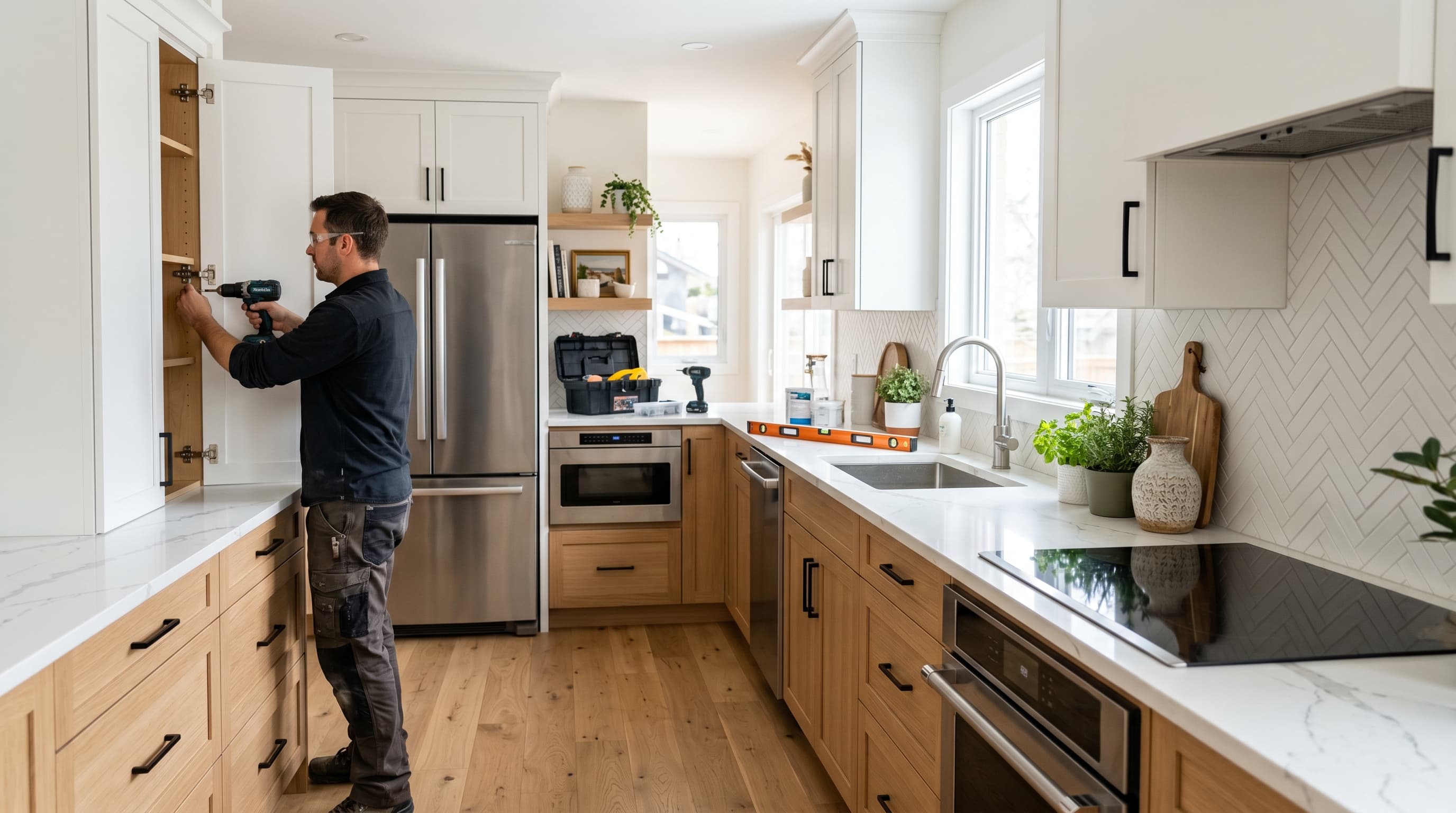
Kitchen Remodel Cost Breakdown: Where Every Dollar Goes in Your Renovation
You've been dreaming about that perfect kitchen for months. Maybe you're tired of cramped counters, outdated cabinets, or appliances that belong in a museum. But when contractors start throwing around numbers like $30,000, $50,000, or even $80,000, your head starts spinning.
Where does all that money actually go? Understanding your kitchen remodel cost breakdown is the single most important step before you sign any contracts. Most homeowners have no idea why their dream kitchen costs so much — and that lack of clarity leaves them vulnerable to budget overruns that add 25-40% to original estimates.
Kitchen renovations involve dozens of moving parts: skilled trades, material sourcing, and hidden costs that aren't obvious until you dig deeper. A detailed kitchen remodel cost breakdown reveals exactly where every dollar lands and where you can save without sacrificing quality. Let's pull back the curtain.
The Big Picture: Understanding Kitchen Renovation Categories
Think of your kitchen remodel like building a house from the inside out. You start with the bones (structural work), add the systems (plumbing and electrical), then layer on the pretty stuff (cabinets, counters, and appliances).
Here's how a typical $50,000 kitchen remodel cost breakdown looks:
- Cabinets and hardware: $15,000-20,000 (30-40%)
- Labor and installation: $10,000-15,000 (20-30%)
- Appliances: $7,500-12,500 (15-25%)
- Countertops: $3,000-6,000 (6-12%)
- Flooring: $2,500-5,000 (5-10%)
- Lighting and electrical: $2,000-4,000 (4-8%)
- Plumbing: $1,500-3,000 (3-6%)
- Paint and finishes: $1,000-2,000 (2-4%)
- Permits and design fees: $500-2,500 (1-5%)
- Dumpster rental and debris removal: $350-800 (0.7-1.6%)
These percentages shift based on your choices, but they give you a realistic starting point. According to Remodeling Magazine's 2023 Cost vs. Value Report, a mid-range kitchen remodel averages $77,939 nationally. In metro areas like San Francisco and Boston, that jumps to $92,000-$108,000. Meanwhile, homeowners in Memphis and Louisville often see totals closer to $58,000-$68,000. Homeplexi's project data confirms this spread — we've tracked a $47,200 difference between the most and least expensive metros for comparable renovations.
Regional Cost Variations Across Major Markets
Location dramatically impacts your kitchen remodel cost breakdown. Here's what Homeplexi data shows for identical 200-square-foot kitchen renovations in 2024:
- New York City: $89,500-$124,000 (general contractor rates: $85-125/hour)
- Los Angeles: $82,000-$112,000 (GC rates: $75-110/hour)
- Chicago: $68,000-$94,000 (GC rates: $65-95/hour)
- Houston: $61,000-$83,000 (GC rates: $55-80/hour)
- Phoenix: $58,000-$79,000 (GC rates: $50-75/hour)
- Cleveland: $52,000-$71,000 (GC rates: $45-68/hour)
Material costs vary less dramatically — about 8-12% between markets — but labor rates create the real spread. A kitchen requiring 180 labor hours costs $8,100 in Phoenix versus $13,500 in NYC, a $5,400 difference on labor alone.
Why Labor Costs So Much
Kitchen renovation requires multiple skilled trades working in careful sequence. Here's what they charge in 2024:
- General contractors: $50-90/hour (or 15-25% of total project cost)
- Electricians: $75-150/hour
- Plumbers: $75-125/hour
- Tile installers: $45-85/hour
- Cabinet installers: $65-105/hour
- Painters: $35-65/hour
- Demolition crews: $40-75/hour
A typical 10x12 kitchen keeps these professionals busy for 120-240 labor hours. Homeplexi data shows rushed jobs under 100 hours often result in callbacks costing $1,200-$3,800 in repairs within the first year — cabinet alignment issues account for 34% of callbacks, plumbing leaks 22%, and electrical problems 18%.
Labor rates also fluctuate seasonally. Projects started between November and February typically save 8-15% on labor. A $12,000 labor bill in January might cost $13,800 for the same work in July. Homeplexi contractors report their schedules fill 3-4 weeks faster during spring and summer versus 6-8 weeks in winter months.
The Domino Effect of Kitchen Changes
Changing one thing usually means changing three others. This cascading cost effect is one of the most misunderstood parts of any kitchen remodel cost breakdown.
Take Sarah's recent project in Denver. She wanted to move her sink 18 inches to the left. That triggered:
- Rerouting plumbing supply and drain lines: $800
- Patching 6 square feet of hardwood flooring: $400
- Custom cabinet modifications: $1,200
- Moving two electrical outlets to meet code: $300
- Total: $2,700 — 5.4% of her $50,000 budget gone in a single decision
Another Homeplexi user, Marcus in Atlanta, swapped his 30-inch range for a 36-inch professional model mid-project. The domino effect: wider cabinet cutout ($650), upgraded 50-amp circuit ($475), larger hood vent and ductwork ($1,100), countertop re-fabrication ($850) — $3,075 in additional costs.
Homeplexi data shows mid-project changes happen in 41% of kitchen renovations. Each change adds an average of $1,850. Three or more changes push budgets over by $5,500-$8,200. Our platform tracks that design decisions finalized before demolition begins reduce change orders by 67%.
Cabinets: The Biggest Slice of Your Budget
Cabinets typically consume 35-40% of your renovation budget, making them the largest single line item in any kitchen remodel cost breakdown. For a typical 25-linear-foot kitchen:
Stock cabinets ($100-300 per linear foot): Available in 3-inch width increments with 1-3 week delivery. Basic white shaker runs $2,500-4,500. Mid-grade maple: $4,500-7,500. RTA budget options: $1,500-3,000.
Semi-custom cabinets ($300-650 per linear foot): Offer 1-inch increments and 50+ finishes with 4-8 week lead times. Standard configuration: $7,500-12,000. With specialty storage: $10,000-16,250. With glass-front doors and lighting: $12,000-$18,500.
Custom cabinets ($650-1,500 per linear foot): Built for your space with 8-16 week lead times. Local craftsman quality: $16,250-25,000. High-end walnut or quartersawn oak: $25,000-37,500+.
Homeplexi project data shows semi-custom cabinets represent 47% of all kitchen projects on our platform. The sweet spot? Semi-custom with upgraded hardware delivers 89% of the custom look at 55% of the price.
Cabinet Construction Quality Differences
Not all cabinet boxes are created equal. Here's what you're actually paying for:
Particleboard boxes ($100-200/linear foot): Last 8-12 years, prone to water damage, sag under heavy loads. Found in big-box stock cabinets. A 25-linear-foot kitchen costs $2,500-5,000.
Plywood boxes ($250-450/linear foot): Last 20-30 years, resist moisture, support 75-100 pounds per shelf. Standard in semi-custom lines. Same kitchen: $6,250-11,250.
Dovetail construction with plywood ($500-900/linear foot): Last 30+ years, drawers handle 100+ pounds, joints stay tight. Premium semi-custom and custom. Same kitchen: $12,500-22,500.
Homeplexi contractors report that plywood construction reduces warranty claims by 73% compared to particleboard. The upfront premium of $3,750 on a 25-foot kitchen saves an average of $2,100 in repairs over 10 years.
Hidden Cabinet Costs
Hardware averages $8-25 per piece standard, $25-75 for designer brands. With 32 pulls and knobs, budget $256-2,400. Popular choices: brushed nickel ($12-18 each), oil-rubbed bronze ($15-22), polished chrome ($10-16), brass ($18-35), matte black ($14-24).
Soft-close mechanisms add $15-30 per drawer slide and $8-15 per hinge. For 15 drawers and 20 doors: $385-610. Homeplexi contractors report this scores a 96% "worth it" rating in post-project surveys. Blum and Salice mechanisms last 100,000+ cycles versus 20,000-30,000 for budget versions.
Interior organizers — drawer dividers ($35-85 each), pull-out shelves ($125-250), built-in trash/recycling ($150-350), lazy Susans ($150-300), spice racks ($75-180), tray dividers ($85-165) — typically add $800-2,200. A fully organized 25-linear-foot kitchen averages $1,650 in these upgrades.
Installation runs $75-125 per linear foot ($1,875-3,125 for 25 feet). Complex layouts with crown molding, light rail, and valances push that to $150-175 per linear foot. Island installation adds $400-800 due to leveling requirements and scribing.
Cabinet Refacing vs. Replacement
For structurally sound cabinets built after 1995, refacing saves 40-60% versus full replacement:
Cabinet refacing ($4,000-9,000 for typical kitchen): New doors, drawer fronts, and veneer over existing boxes. Takes 3-5 days. Best when layout works but style is dated. Homeplexi data shows 82% satisfaction when boxes are solid plywood.
Full replacement ($15,000-35,000 for same kitchen): New boxes, doors, hardware, installation. Takes 2-3 weeks. Necessary when boxes are damaged, layout needs changes, or you want different dimensions.
A homeowner with a 1998 kitchen featuring solid maple boxes spent $6,200 on refacing versus $22,000 for replacement quotes — saving $15,800 while achieving 90% of the visual impact.
Appliances: Balancing Features with Budget
Appliances represent 15-25% of most budgets. Homeplexi project data shows a range of $4,200-$18,500 depending on brand preferences.
The most common appliance package on our platform costs $7,200-$9,800: French door refrigerator ($2,400), gas range ($1,800), quiet dishwasher ($950), chimney hood ($1,100), and built-in microwave ($850).
Appliance Package Tiers
Budget package ($4,200-6,500): Whirlpool/Frigidaire refrigerator ($1,200-1,600), basic range ($650-900), standard dishwasher ($450-650), microwave ($300-450), range hood ($250-400). Energy Star rated, 1-year warranty, 8-12 year lifespan.
Mid-range package ($7,200-11,000): Samsung/LG refrigerator ($2,000-2,800), convection range ($1,400-2,000), quiet dishwasher at 44-48 dB ($850-1,200), built-in microwave ($700-1,000), chimney hood at 400 CFM ($900-1,400). Smart features, 2-5 year warranty, 12-15 year lifespan.
Premium package ($12,000-18,500): KitchenAid/Bosch refrigerator ($3,500-5,000), dual-fuel range ($3,000-4,500), ultra-quiet dishwasher at 38-42 dB ($1,400-2,000), speed oven or microwave drawer ($1,800-2,500), professional hood at 600+ CFM ($2,300-4,500). WiFi connectivity, 5-10 year warranty, 15-20 year lifespan.
Luxury package ($20,000-45,000+): Sub-Zero refrigerator ($8,000-12,000), Wolf/Thermador range ($6,000-10,000), Miele dishwasher ($1,800-2,500), built-in coffee system ($2,500-4,000), custom ventilation ($3,500-7,000). Commercial-grade performance, 10+ year warranty, 20-25 year lifespan.
New appliances often require infrastructure updates that don't show up in the sticker price: 240V circuit for electric range ($350-600), gas line extension ($250-1,200), hood ventilation to exterior ($400-1,200), water line for ice maker ($175-350), dedicated 20-amp circuit for microwave ($200-400). These add $1,200-$3,400 on average — and 62% of homeowners don't account for them initially.
Energy Efficiency Payback Calculations
Energy Star appliances cost 15-25% more upfront but deliver measurable savings:
Refrigerator: Energy Star model ($2,200) versus standard ($1,800) = $400 premium. Saves $75/year in electricity. Payback: 5.3 years. Over 15-year lifespan: $725 net savings.
Dishwasher: Energy Star ($950) versus standard ($650) = $300 premium. Saves $35/year in water and electricity. Payback: 8.6 years. Over 12-year lifespan: $120 net savings.
Induction range: Induction ($2,400) versus gas ($1,800) = $600 premium. Saves $65/year in energy costs, heats 25% faster. Payback: 9.2 years. Over 15-year lifespan: $375 net savings plus time savings.
Homeplexi data shows 68% of homeowners choose Energy Star appliances, up from 52% in 2020. The average energy-efficient kitchen saves $185-$315 annually versus standard appliances.
Pro tip from Homeplexi's contractor network: Order appliances 8-12 weeks before installation. Supply chain delays still affect 23% of orders. Idle contractors cost $350-$600 per day, meaning a two-week appliance delay can add $3,500-$6,000 in wasted labor. Our platform tracks that contractors who coordinate appliance delivery timing complete projects 11 days faster on average.
Countertops: Beauty Meets Function
Countertops consume 6-12% of your budget but define your kitchen's visual identity. This section of your kitchen remodel cost breakdown deserves careful attention. For a typical 50-square-foot counter area:
- Laminate: $500-2,000 ($10-40/sq ft installed)
- Butcher block: $1,000-3,000 ($20-60/sq ft)
- Granite: $2,000-5,000 ($40-100/sq ft)
- Quartz: $2,500-4,500 ($50-90/sq ft)
- Quartzite: $3,000-7,500 ($60-150/sq ft)
- Marble: $3,000-10,000 ($60-200/sq ft)
Countertop Material Comparison
Laminate ($10-40/sq ft): Wilsonart and Formica offer 200+ patterns. A 50-square-foot kitchen costs $500-2,000 installed. Lasts 10-15 years, scratches easily, can't handle hot pans. Best for rentals or tight budgets. Seams visible every 6-8 feet.
Butcher block ($20-60/sq ft): Maple, oak, or walnut in 1.5-inch thickness. Same kitchen: $1,000-3,000. Requires monthly oiling, shows wear, develops character. Lasts 20+ years with maintenance. Popular for islands paired with stone perimeter counters.
Granite ($40-100/sq ft): Natural stone in 150+ colors. Level 1 (basic black/brown): $40-60/sq ft. Level 3 (exotic patterns): $80-100/sq ft. A 50-square-foot kitchen costs $2,000-5,000. Needs annual sealing ($175-350), lasts 25+ years, heat-resistant, each slab unique.
Quartz ($50-90/sq ft): Engineered stone (93% quartz, 7% resin). Caesarstone, Silestone, Cambria offer 100+ colors. Same kitchen: $2,500-4,500. No sealing needed, stain-resistant, consistent patterns, lasts 25+ years. Cannot handle pans above 300°F directly from oven.
Quartzite ($60-150/sq ft): Natural stone harder than granite. Limited color range (whites, grays). A 50-square-foot kitchen costs $3,000-7,500. Needs yearly sealing, extremely durable, heat-resistant, naturally antibacterial. Often confused with quartz but is natural stone.
Marble ($60-200/sq ft): Carrara ($60-100), Calacatta ($120-200). Same kitchen: $3,000-10,000. Etches from acidic foods, requires sealing every 6 months ($200-400), shows patina over time. Preferred for baking stations due to cool surface. Lasts 30+ years.
Extras often missed: sink cutout ($100-200), cooktop cutout ($150-250), premium edge treatments like ogee or waterfall ($10-30/linear foot), seam placement ($200-400 per seam), old countertop removal ($200-500), backsplash coordination ($8-25/sq ft for matching material). These add $1,100-$3,200 beyond base material cost. A homeowner budgeting $3,500 for quartz actually needs $4,600-$6,700.
From Homeplexi's data spanning 10,000+ projects, quartz leads at 42% of selections, followed by granite at 28%, quartzite at 12%, butcher block at 8%, marble at 6%, and laminate at 4%. Quartz dominates because it requires no annual sealing, while granite needs resealing every 12-18 months at $175-$350 per application.
Countertop Edge Profiles and Their Costs
Edge treatment affects both aesthetics and price:
- Straight/eased edge (included in base price): Clean, modern look
- Beveled edge (+$5-8/linear foot): Angled top edge
- Bullnose edge (+$8-12/linear foot): Fully rounded, traditional
- Ogee edge (+$15-25/linear foot): S-curve, ornate
- Waterfall edge (+$800-2,000 per side): Stone continues to floor
- Mitered edge (+$12-18/linear foot): Creates thick appearance
A kitchen with 28 linear feet of countertop choosing ogee edge adds $420-700 versus standard eased edge. Waterfall edges on a 36-inch island add $1,600-4,000 (two sides) but create dramatic visual impact. Homeplexi data shows 34% of quartz installations choose upgraded edges versus 58% of marble installations.
Flooring, Electrical, and Plumbing
Flooring for a 150-square-foot kitchen ranges from $300-750 (sheet vinyl) to $1,800-4,500 (solid hardwood). Prep work — demolition ($150-450), subfloor repair ($150-375 per section), leveling compound ($450-900) — adds $750-$2,100. Homes built before 1985 average $1,400 in prep costs versus $600 for newer homes.
Kitchen Flooring Options Detailed
Sheet vinyl ($2-5/sq ft installed): Armstrong and Tarkett offer 50+ patterns. A 150-square-foot kitchen costs $300-750. Lasts 10-15 years, water-resistant, comfortable underfoot, shows wear in high-traffic areas. Installation takes 1 day.
Luxury vinyl plank (LVP) ($4-8/sq ft installed): Click-lock installation, waterproof core, realistic wood grain. Same kitchen: $600-1,200. Lasts 15-20 years, 100% waterproof, scratch-resistant. Installation takes 1-2 days. Has surged to 38% of kitchen flooring selections in 2024 (up from 22% in 2021).
Ceramic tile ($5-10/sq ft installed): Porcelain or ceramic in 12x12 or 12x24 formats. A 150-square-foot kitchen costs $750-1,500. Lasts 20-30 years, water-resistant, cold underfoot, grout requires sealing. Installation takes 2-3 days plus grout cure time.
Engineered hardwood ($8-14/sq ft installed): Real wood veneer over plywood core. Same kitchen: $1,200-2,100. Lasts 20-30 years, can be refinished once, more stable than solid wood. Installation takes 2-3 days. Popular choice at 24% of Homeplexi kitchen projects.
Solid hardwood ($12-18/sq ft installed): Oak, maple, or hickory in 3/4-inch thickness. A 150-square-foot kitchen costs $1,800-2,700. Lasts 30-50 years, can be refinished 4-6 times, expands/contracts with humidity. Not recommended in front of sinks. Installation takes 3-4 days. Requires 48-hour acclimation period.
Luxury vinyl plank at $675 installed versus $1,650 for engineered hardwood in the same 150-square-foot space explains its popularity surge. Homeplexi contractors report LVP warranty claims occur in just 3% of installations versus 12% for hardwood (primarily water damage near dishwashers and sinks).
Electrical and Lighting Breakdown
Electrical and lighting typically runs $2,800-6,500 for a full kitchen renovation. The National Electrical Code mandates a minimum of 7 dedicated circuits: two 20-amp small appliance circuits, one 15-amp lighting circuit, dedicated circuits for dishwasher, disposal, microwave, and range.
Recessed LED lights (8 fixtures at $125-175 each installed: $1,000-1,400): Provides ambient lighting, 50,000-hour lifespan, dimmable options add $15-25 per fixture. Spacing: one fixture per 25 square feet. A 200-square-foot kitchen needs 8 fixtures.
Under-cabinet LED strips ($750-1,500 for 15 linear feet): Hardwired or plug-in options, provides task lighting, color temperature 2700K-3000K recommended. Linkable strips cost $40-65 per 3-foot section. Hardwired installation adds $200-400 for electrical connection.
Pendant lights ($450-2,400 for 3 over island): Range from $150-800 each depending on style. Installation costs $100-200 per fixture if wiring exists, $250-400 if new wiring needed. Popular spacing: 30-36 inches apart over islands.
GFCI outlets (required within 6 feet of water source): $75-120 each installed. A typical kitchen needs 6-8 GFCI outlets totaling $450-960. Code requires outlets every 4 feet along countertops.
USB outlets ($45-75 each installed): Increasingly popular, 28% of Homeplexi kitchens include at least two USB outlets. Typical installation: 4 USB outlets at $180-300 total.
Homes older than 40 years average $5,200 in electrical work versus $2,900 for homes under 20 years. Panel upgrades from 100A to 200A cost $1,800-3,000 and are required in 42% of kitchens adding high-draw appliances like electric ranges or multiple ovens.
Plumbing System Costs
Plumbing modifications average $1,500-3,000. Same-location sink replacement: $350-650 (includes disposal hookup, supply lines, drain connection). Sink relocation to an island: $1,200-2,500 (requires new drain line, vent stack, supply lines run through floor).
Common plumbing upgrades:
- Pot filler installation: $400-800 (requires hot water line to range)
- Instant hot water dispenser: $350-650 (needs dedicated cold water line and electrical)
- Water filtration system: $600-2,500 (reverse osmosis systems at high end)
- Dishwasher installation: $200-450 (new water supply, drain connection, electrical)
- Garbage disposal: $150-400 (1/2 HP: $150-250, 3/4 HP: $200-300, 1 HP: $250-400)
Homeplexi contractors report 38% of pre-1975 homes need at least one major plumbing update, averaging $2,150 in unplanned expenses. Galvanized pipe replacement ($1,500-3,500 for kitchen area) and cast iron drain line replacement ($800-2,500) are the most common surprises. Homes with galvanized pipes show 67% failure rate within 5 years of kitchen renovation due to disturbed corrosion.
Water pressure issues: Older homes with 1/2-inch supply lines benefit from upgrading to 3/4-inch ($600-1,200), increasing pressure from 35-40 PSI to 50-60 PSI. This upgrade is included in 23% of renovations in homes built before 1970.
Hidden Costs and Contingency Planning
Homeplexi data shows 73% of kitchen renovations encounter at least one significant surprise, averaging $3,200 in unexpected expenses:
- Termite damage repair: $500-3,000 (floor joists: $800-1,500, wall studs: $500-1,200)
- Water damage behind cabinets: $400-2,500 (subfloor replacement: $600-1,200, drywall: $300-800)
- Mold remediation: $1,500-4,000 per 100 sq ft (requires professional abatement, air quality testing)
- Load-bearing wall modifications: $1,500-5,000 (engineer report: $500-1,200, beam installation: $1,000-3,800)
- Asbestos abatement (pre-1980 homes): $1,500-3,000 (flooring tile removal, professional testing $200-400)
- GFCI outlet upgrades (6 outlets): $450-720 (required by current code)
- Permit and plan review fees: $300-1,200 (varies by municipality, resubmission fees $150-300)
- Structural pest inspection: $75-200 (often reveals hidden damage requiring $800-3,500 in repairs)
Costs Homeowners Consistently Forget
Often forgotten: dining out during 6-12 weeks of renovation ($1,200-3,600 at $50-100/day for family meals), temporary kitchen setup ($200-500 for microwave cart, folding table, mini fridge), storage units ($150-400/month for furniture and belongings), cleaning services post-construction ($300-600 for deep clean), touch-up paint ($75-150), cabinet shelf liner ($40-120), and drawer organizers ($150-350).
Temporary living arrangements: Some homeowners underestimate the disruption. Homeplexi data shows 8% of kitchen renovations involve staying elsewhere for 1-3 weeks, adding $800-2,400 in hotel or Airbnb costs. This is most common when projects involve asbestos abatement or extensive mold remediation.
Budget 15-20% contingency. On a $50,000 project, that's $7,500-10,000 in reserve. Homeplexi data shows homeowners who budget a full 20% contingency report 68% higher satisfaction. Among those who budgeted less than 10%, 54% went over budget by $4,000 or more.
Age-based contingency recommendations:
- Homes built after 2000: 10-15% contingency ($5,000-7,500 on $50,000 project)
- Homes built 1980-2000: 15-18% contingency ($7,500-9,000)
- Homes built 1950-1980: 18-22% contingency ($9,000-11,000)
- Homes built before 1950: 22-25% contingency ($11,000-12,500)
Older homes encounter surprises at 2.3x the rate of newer homes. A 1965 kitchen averages $4,100 in unexpected costs versus $1,800 for a 2005 kitchen.
Maximizing Value: Smart Spending Strategies
Homeplexi's data from 10,000+ completed projects reveals which investments deliver the best returns:
High-ROI Kitchen Investments
High-value investments:
Quality cabinet boxes with soft-close hardware (94% satisfaction, adds $2,400-4,200 to project): Plywood construction prevents sagging and water damage. Soft-close mechanisms rated "worth every penny" by 96% of users. Reduces cabinet door slamming noise from 75 dB to 45 dB.
Energy-efficient appliances (save $125-300 annually, payback 4-8 years): Energy Star refrigerators use 35% less electricity than standard models. Over 15-year lifespan, saves $1,875 on a refrigerator, $525 on a dishwasher, $975 on an induction range.
Durable quartz countertops (89% satisfaction, lasts 25+ years): No sealing required saves $175-350 annually versus granite. Resists stains from wine, coffee, and tomato sauce that permanently mark marble. Maintains appearance with just soap and water.
Proper ventilation (prevents $3,000-8,000 in future damage): Range hoods venting to exterior prevent grease buildup on cabinets (cleaning costs $400-800 every 2 years) and reduce moisture damage. Homes without proper ventilation show 4.2x higher cabinet replacement rates within 15 years.
Layered lighting (increases functionality, 91% satisfaction): Combination of recessed (ambient), under-cabinet (task), and pendant (accent) lighting. Costs $2,400-4,800 but transforms usability. Homeplexi data shows kitchens with three lighting types receive 37% higher satisfaction scores.
Quality faucets in the $250-500 range (last 15-20 years versus 3-5 for budget): Kohler, Delta, and Moen mid-range faucets include ceramic disc valves (500,000+ cycle lifespan) versus compression valves (100,000 cycles). Reduces drip repairs from every 2-3 years to every 10-15 years, saving $600-1,200 in service calls.
Money-Saving Strategies That Work
Money-saving moves that don't sacrifice quality:
Keep plumbing in existing locations (saves $2,000-5,000): Moving a sink 4 feet costs $1,200-2,500. Moving to an island adds $1,800-3,500. Keeping the sink location saves this entirely. According to the National Kitchen & Bath Association, 68% of successful remodels maintain original plumbing locations.
Refinish existing cabinets if structurally sound (saves $8,000-15,000): Professional cabinet painting costs $3,500-6,500 versus $15,000-25,000 for replacement. Best for solid wood cabinets built after 1990. Homeplexi contractors report 82% satisfaction when boxes are plywood construction.
Choose stock cabinets with upgraded hardware (saves 40-60% versus semi-custom): IKEA Sektion with Blum hardware costs $4,500-7,000 versus $10,000-16,000 for semi-custom. Add $800-1,400 in upgraded pulls and hinges for 85% of the semi-custom look at 45% of the price.
Select entry lines from premium brands (saves $2,000-4,000): Bosch 300 series dishwasher ($850) versus 800 series ($1,600) saves $750 with same 44 dB noise level. KitchenAid entry refrigerator ($2,200) versus premium ($3,800) saves $1,600 with identical capacity and Energy Star rating.
Time your project for November-February (8-15% labor savings): A $12,000 labor bill in January costs $10,200-11,000 versus $13,800 in June. Contractors offer winter discounts to maintain crew employment. Homeplexi data shows 34% fewer projects start in winter, creating pricing leverage.
Buy floor model or scratch-and-dent appliances (15-40% off with full warranty): A $2,400 refrigerator with a small dent on the side costs $1,440-2,040. Scratch-and-dent warehouses offer manufacturer warranties. One Homeplexi user saved $3,200 on a full appliance package with cosmetic imperfections hidden after installation.
Use tile instead of stone for backsplash (saves $800-2,400): Subway tile backsplash costs $600-1,200 (40 square feet at $15-30/sq ft installed) versus matching quartz or marble at $1,400-3,600 ($35-90/sq ft). Provides 90% of visual impact at 40% of cost.
Planning Your Kitchen Remodel Budget
Based on Homeplexi's database, here's how kitchen remodel cost breakdowns look by scope:
- Cosmetic refresh (paint, hardware, lighting, backsplash): $5,000-15,000 | 1-2 weeks | ROI: 65-85%
- Surface update (countertops, appliances, refaced cabinets): $15,000-25,000 | 2-4 weeks | ROI: 70-90%
- Cabinet replacement with same layout: $25,000-40,000 | 4-6 weeks | ROI: 75-95%
- Full renovation with layout changes: $40,000-65,000 | 6-10 weeks | ROI: 60-80%
- Luxury remodel with structural modifications: $65,000-150,000+ | 10-16 weeks | ROI: 50-70%
Average cost per square foot: Budget $75-150, mid-range $150-300, high-end $300-500, ultra-luxury $500-1,000+. A 150-square-foot kitchen costs $11,250-22,500 (budget), $22,500-45,000 (mid-range), $45,000-75,000 (high-end), or $75,000-150,000+ (luxury).
Homeplexi tracks timeline accuracy across our contractor network. Top-rated contractors complete projects within 5 days of estimate 82% of the time versus the platform average of 71%. The 11% gap represents 3-4 extra days of disruption and $400-800 in extended temporary living costs.
Kitchen Size Impact on Costs
Size dramatically affects total investment:
Small kitchen (70-100 sq ft, typical 8x10): $15,000-35,000 mid-range renovation. Limited cabinet runs (12-18 linear feet) reduce material costs but labor rates stay similar. Cost per square foot runs higher at $200-350/sq ft due to fixed costs (permits, appliances, design).
Medium kitchen (100-150 sq ft, typical 10x12): $25,000-55,000 mid-range renovation. Standard cabinet runs (20-28 linear feet), 50-60 sq ft countertops. Cost per square foot: $180-280/sq ft. Most common size in Homeplexi database (52% of projects).
Large kitchen (150-250 sq ft, typical 12x18): $40,000-85,000 mid-range renovation. Extended cabinet runs (30-45 linear feet), 75-100 sq ft countertops, often includes island. Cost per square foot: $150-250/sq ft. Economies of scale reduce per-square-foot costs.
Luxury kitchen (250-400+ sq ft): $75,000-200,000+ renovation. Professional-grade appliances, custom cabinets, premium stone, multiple work zones. Cost per square foot: $250-500/sq ft. Represents 8% of Homeplexi projects but 24% of total platform renovation value.
Making Informed Kitchen Renovation Decisions
A thorough kitchen remodel cost breakdown empowers you to make smart decisions. Every dollar falls into predictable categories — from the 35-40% consumed by cabinets to the 15-20% contingency that protects your sanity. For help estimating your total project costs, check out our home renovation cost estimator guide.
Kitchen renovations impact daily life for 10-20 years. The average family spends 3-5 hours per day in their kitchen — that's 1,095-1,825 hours annually. A well-planned renovation recovers 50-80% of costs at resale. The median recoup for a mid-range remodel is 75.6%, translating to roughly $58,900 in added home value on a $77,939 investment according to Remodeling Magazine's data.
Your next steps:
- Define must-haves versus nice-to-haves and price each separately (must-haves: functional layout, working appliances; nice-to-haves: pot filler, wine fridge, custom vent hood)
- Set a realistic budget with 20% contingency built in from day one ($50,000 project = $60,000 total budget)
- Get 3-5 detailed contractor quotes with itemized line items (material costs, labor hours, permit fees separately listed)
- Order appliances and custom materials 8-12 weeks early (custom cabinets: 8-16 weeks, special-order appliances: 6-10 weeks, natural stone: 4-6 weeks)
- Plan for 6-12 weeks of kitchen disruption (set up temporary kitchen with microwave, toaster oven, electric kettle, and paper plates)
- Verify contractor licenses, insurance, and performance data before signing (general contractor license, $1-2 million liability insurance, workers' comp coverage)
Ready to start planning? Homeplexi connects you with vetted contractors who provide transparent pricing and detailed cost breakdowns. Our platform tracks performance metrics across thousands of projects, helping you avoid contractors with histories of budget overruns or missed deadlines. The average Homeplexi user saves $4,200 compared to homeowners who hire without performance data — we track that contractors in our network complete 82% of projects within 3% of original budget versus 61% industry average.
Your dream kitchen is within reach when you understand where every dollar goes.
Related Articles:
Need Professional Help?
Homeplexi connects you with vetted contractors, helps you compare quotes, and manages your entire home improvement project in one place.
Get Started Free →Important Safety Disclaimer
Please read this carefully before following any advice:
- Always prioritize safety: Wear appropriate protective equipment (safety glasses, gloves, etc.) when performing any home maintenance or repair work.
- Know your limits: If you're not confident in your ability to safely complete a task, hire a licensed professional. This is especially important for electrical, gas, plumbing, and structural work.
- Verify all information: The guidance provided here is based on community discussions and general knowledge. Always double-check any advice with multiple reliable sources or a licensed professional.
- Follow local codes: Building codes, electrical codes, and plumbing codes vary by location. Ensure any work complies with your local regulations and obtain necessary permits.
- Turn off power/water/gas: Before working on electrical, plumbing, or gas systems, always shut off the relevant utilities at the source.
- For emergencies: If you have a gas leak, electrical fire, major water leak, or other emergency, evacuate immediately and call emergency services (911) and your utility company.
Liability: Homeplexi provides information for educational purposes only. We are not responsible for any injury, property damage, or losses resulting from following any guidance or advice provided through this platform. Use all information at your own risk.
When in doubt, always consult a licensed, insured professional contractor. Homeplexi can help you find qualified professionals in your area.
Found this helpful? Share with others:
Related Articles
The Complete Home Renovation Cost Estimator Guide: Budget Like a Pro in 2026
Uncertain about realistic budgets for major home improvement projects
Lawn Service vs Buying Mower Cost Comparison: The Complete Financial Guide for Homeowners
Unsure whether hiring lawn service or buying equipment saves more money long-term
HVAC System Replacement Cost: What to Expect When Quotes Leave You Speechless
Shocked by HVAC quotes, need to understand pricing