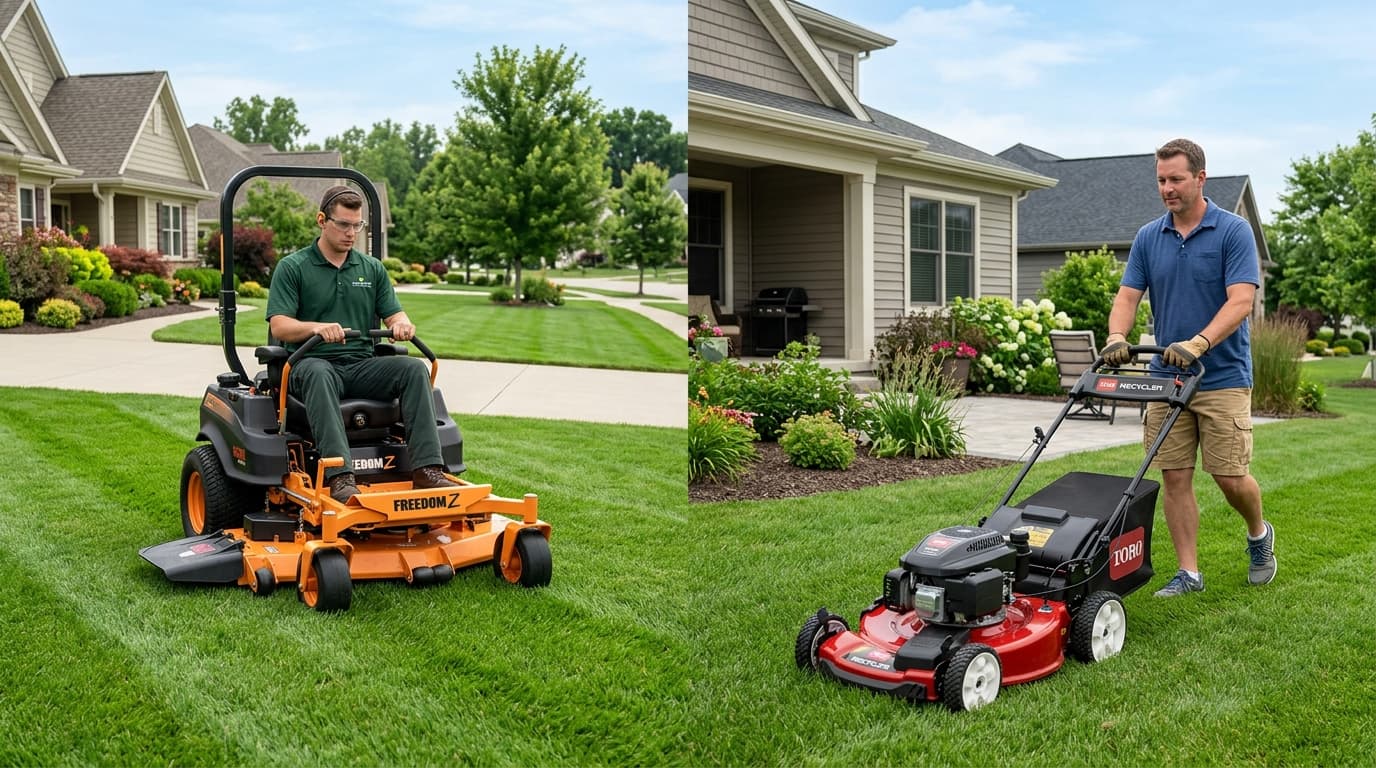
You're standing in your yard on a Saturday morning, looking at grass that's grown too tall again. The question hits you like it has dozens of times before: "Should I keep paying for lawn service, or would buying my own mower actually save money?" You're not alone in this lawn service vs buying mower cost comparison dilemma. Nearly 77% of American households face this exact decision, and the answer isn't as straightforward as you might think.
The truth is, a thorough lawn service vs buying mower cost comparison involves far more than just the sticker price of equipment versus monthly service fees. Hidden costs lurk everywhere – from maintenance and storage to your own time and the learning curve of proper lawn care. Some homeowners save thousands by switching to DIY lawn care, while others end up spending more and getting worse results. This comprehensive guide breaks down every cost factor, timeline consideration, and practical scenario to help you make the right financial decision for your specific situation. By the end, you'll have a clear framework for calculating your true costs and a step-by-step plan for whichever path makes the most sense for your budget and lifestyle.
Understanding the Real Cost of Professional Lawn Service
Breaking Down Monthly and Annual Service Fees
Professional lawn service costs vary dramatically based on your location, lawn size, and service level. According to the U.S. Bureau of Labor Statistics, the grounds maintenance industry has seen wages rise 4.2% year-over-year, which directly impacts what homeowners pay. Here's what most homeowners actually pay in 2025:
Basic mowing and edging typically runs $30-80 per visit for average suburban lots (quarter-acre or less). In high-cost metros like San Francisco or New York, expect $75-120 per visit, while homeowners in the Midwest and South often pay $30-50. If you schedule bi-weekly service during growing season (roughly 7 months or 28-32 weeks), that's $420-1,120 annually just for basic cuts.
Full-service lawn care including fertilization, weed control, aeration, overseeding, and seasonal treatments ranges from $100-300 per month during active season. Annual costs often reach $1,200-3,600 for comprehensive care. Premium services that include pest control, irrigation management, and landscape maintenance can push costs to $4,800-6,000 annually.
Hidden Fees and Service Limitations
Most lawn services include surprise costs that homeowners discover too late. When your grass grows extra tall due to service delays, some companies charge premium rates for the "tall grass surcharge" – typically $10-25 extra per visit when grass exceeds 6 inches.
Property access requirements often mean you must be home or leave gates unlocked. This creates security concerns or schedule conflicts. Some services charge $15-25 "lockout fees" when they arrive and can't access the property.
Service boundaries typically exclude areas like steep slopes, tight spaces around landscaping, or sections with sprinkler heads. You'll still handle these areas yourself or pay extra fees of $20-40 per visit for "difficult terrain" surcharges.
Seasonal surcharges also catch homeowners off guard. Fall leaf cleanup adds $150-400 annually. Spring dethatching costs $100-250. These services are rarely included in standard mowing contracts, yet they're essential for lawn health.
Quality and Consistency Challenges
Professional services face high employee turnover – often 50-70% annually in the landscaping industry, according to the National Association of Landscape Professionals. This means different crews with varying skill levels and attention to detail visit your property. Mike from Phoenix learned this the hard way when three different crews in one season left his St. Augustine grass scalped to 1.5 inches instead of the recommended 3.5-4 inches. They damaged his sprinkler heads twice (costing $85 per repair) and consistently missed edging around his driveway.
The lack of control over scheduling becomes particularly frustrating during peak growing periods. Your grass might need cutting every 5-6 days, but your service only comes every 14 days. During rainy stretches in spring, this gap can result in grass reaching 8-10 inches, stressing the turf and creating an uneven cut.
Communication gaps add another layer of frustration. A 2024 HomeAdvisor survey found that 43% of homeowners reported difficulty reaching their lawn service provider to address quality issues or schedule changes.
The True Cost of Buying and Maintaining Your Own Mower
Initial Equipment Investment Breakdown
When calculating your lawn service vs buying mower cost comparison, most homeowners underestimate the total equipment investment needed for proper lawn care by 30-40%.
Walk-behind mowers for small to medium lots (under half-acre) range from $300-800 for reliable gas models. Electric corded options run $200-400, battery-powered mowers cost $400-900 for residential models and $800-1,200 for commercial-grade battery units, while self-propelled gas mowers fall in the $450-900 range. However, the mower represents just 60-70% of your total equipment needs.
Essential additional tools include:
- String trimmer/edger: $150-400 (battery models: $200-350; gas models: $180-400)
- Leaf blower: $100-300 (battery: $150-250; gas backpack: $250-500)
- Basic hand tools (rake, shovel, broadcast spreader, garden hose nozzle): $100-200
- Safety equipment (ANSI-rated eye protection, ear protection rated 25+ NRR, work gloves, steel-toe boots): $50-150
- Fuel containers and stabilizer: $25-40
For larger properties over half-acre, riding mowers or zero-turn mowers become necessary. Quality riding mowers start around $1,500-3,000 for 30-42 inch deck models, while zero-turn models range from $3,000-8,000+ for 42-60 inch commercial decks. A reliable mid-range zero-turn with a 48-inch deck and 22 HP engine typically costs $4,200-5,500.
Total initial investment examples:
- Small lot (under 1/4 acre): $650-1,400
- Medium lot (1/4 to 1/2 acre): $900-2,200
- Large lot (1/2 to 1 acre): $2,500-6,500
- Estate property (1+ acre): $5,000-12,000+
Ongoing Maintenance and Operating Costs
Equipment ownership involves continuous expenses that many homeowners overlook when doing their lawn service vs buying mower cost comparison:
Annual maintenance costs typically run 10-15% of equipment value. For a $600 walk-behind mower, expect $60-90 yearly for:
- Oil changes (2-3 times per season, using SAE 30 or 10W-30): $15-25
- Air filter replacement (every 25-50 hours of use): $10-15
- Spark plug replacement (annually): $5-10
- Blade sharpening/replacement (sharpen every 20-25 hours, replace annually): $20-40
- Fuel and oil (approximately 0.5-1 gallon per mowing session): $30-50
- Belt replacement (every 2-3 seasons): $15-30
For riding mowers, annual maintenance costs jump to $150-350, including hydraulic fluid changes ($30-50), battery replacement every 2-3 years ($45-80), and tire maintenance ($20-40).
Major repairs inevitably arise. Engine problems, transmission issues, or deck damage can cost $200-800. A carburetor rebuild runs $150-250, while a hydrostatic transmission replacement on a riding mower can hit $800-1,200. This sometimes exceeds the mower's remaining value, forcing premature replacement.
Battery replacement costs for electric mowers deserve special attention. Replacement lithium-ion battery packs cost $150-400 and typically last 3-5 years or 500-800 charge cycles, whichever comes first.
Storage and Depreciation Factors
Storage requirements create additional costs that factor into any honest lawn service vs buying mower cost comparison. Mowers need protected storage – either garage space (valuable real estate in most homes, with the average two-car garage providing only 400-600 square feet) or a shed ($500-2,000 for adequate storage buildings, or $2,500-5,000 for a professionally installed 8×10 structure).
Climate matters for storage, too. In regions with harsh winters, improper winterization leads to carburetor damage, cracked engine blocks, and corroded fuel systems. Proper winterization supplies (fuel stabilizer, fogging oil, battery tender) cost $25-50 annually but save hundreds in preventable repairs.
Equipment depreciation follows predictable patterns. Most mowers lose 20-30% of value annually for the first three years, then 10-15% thereafter. A $800 mower purchased new becomes worth roughly $400 after three years, assuming good condition. Riding mowers retain value slightly better, losing 15-25% annually, with well-maintained name-brand models (John Deere, Honda, Husqvarna) holding 50-60% of value after five years.
Time Investment: The Hidden Cost Factor
Learning Curve and Skill Development
DIY lawn care requires genuine skill development that takes time and often involves costly mistakes. Proper mowing patterns, cutting height adjustments, and seasonal timing aren't intuitive – and getting them wrong can damage your lawn in ways that cost real money to fix. If you're tackling broader yard issues beyond just mowing, our guide on how to fix lawn and garden problems yourself covers the most common DIY mistakes and budget-friendly solutions.
Seasonal knowledge becomes crucial for timing fertilization, pre-emergent applications (which must go down when soil temperatures reach 55°F for 3-5 consecutive days), and winterization. Many new DIY lawn care enthusiasts spend $200-500 on products they apply incorrectly or at wrong times. Over-fertilizing alone can burn grass, requiring $150-300 in remediation costs.
Most homeowners report reaching competency after 1-2 full growing seasons, with genuinely skilled results appearing in year 3. The first-year learning curve typically adds $200-600 in avoidable costs.
Weekly Time Commitment Reality
Actual mowing time for typical quarter-acre lots ranges from 45-90 minutes. This includes 10-15 minutes for setup and equipment checks, 25-45 minutes of actual mowing, 10-15 minutes of trimming and edging, and 5-10 minutes for cleanup and equipment storage. However, total lawn care time including seasonal tasks averages 3-4 hours monthly during growing season and 6-8 hours monthly during peak spring and fall periods.
Here's a realistic annual time breakdown for a quarter-acre lot:
- Mowing and trimming: 26-30 sessions × 1-1.5 hours = 26-45 hours
- Fertilization and weed control: 4-6 applications × 1 hour = 4-6 hours
- Seasonal cleanup (spring/fall): 8-12 hours
- Equipment maintenance: 4-6 hours
- Aeration and overseeding: 3-4 hours
- Total annual time investment: 45-73 hours
Consider the opportunity cost of this time. If you earn $25/hour at work, those 60 average annual hours represent $1,500 in lost potential income. Even valuing personal time at $15/hour, that's $900 annually. This suddenly makes that $60 lawn service visit look more attractive from a pure economics standpoint.
Physical Demands and Safety Considerations
Lawn care involves genuine physical demands and safety risks. Heat-related illness sends thousands to emergency rooms annually during summer months – the CDC reports over 67,000 heat-related ER visits per year, with outdoor yard work being a leading cause among homeowners. Equipment-related injuries from mowers cause over 80,000 ER visits yearly, with the average ER visit costing $1,500-3,000 out of pocket even with insurance.
Physical limitations affect many homeowners. Arthritis, back problems, or heart conditions can make lawn care dangerous or impossible, regardless of cost considerations. Push mowing burns approximately 250-350 calories per hour and involves repetitive motion that can aggravate existing joint issues. Even riding mowers expose operators to vibration that can worsen lower back conditions over time.
Noise exposure is another consideration. Gas mowers produce 85-95 decibels, exceeding the 85 dB threshold where hearing damage begins. Without proper ear protection, regular mowing can contribute to gradual hearing loss over years.
Detailed Cost Comparison Scenarios
Small Lot Scenario (Under 1/4 Acre)
Let's examine Tom's situation with his 0.15-acre suburban lot in Charlotte, North Carolina:
Professional Service Route:
- Bi-weekly mowing (March through September): $35 × 16 visits = $560
- Quarterly treatments (fertilization, pre-emergent, weed control, winterizer): $75 × 4 = $300
- Annual total: $860
- Five-year cost (with 4% annual increases): $4,660
- Ten-year cost: $10,330
DIY Equipment Route:
- Initial investment: $750 (Honda HRN216 mower at $430, string trimmer at $180, basic tools and safety gear at $140)
- Annual operating costs: $85 (fuel: $35, maintenance: $30, blade/filters: $20)
- DIY fertilizer and treatment products: $120/year
- Mower replacement at year 7: $500
- Five-year total: $1,775
- Ten-year total: $3,350
- Five-year savings: $2,885
- Ten-year savings: $6,980
However, Tom must invest 45-55 hours annually and handle his own treatments/fertilization. At a $25/hour opportunity cost, his time investment adds $1,125-1,375 annually, which would actually make professional service cheaper if he values his time at that rate.
Medium Lot Scenario (1/4 to 1/2 Acre)
Maria's half-acre property in suburban Columbus, Ohio presents different economics:
Professional Service Route:
- Bi-weekly mowing (April through October): $65 × 16 visits = $1,040
- Full treatment program (6 applications): $150 × 6 = $900
- Fall leaf cleanup: $250
- Spring dethatching: $175
- Annual total: $2,365
- Five-year cost (with 4% annual increases): $12,830
- Ten-year cost: $28,410
DIY Equipment Route:
- Initial investment: $2,800 (Husqvarna riding mower at $2,100, trimmer at $280, blower at $220, tools and safety gear at $200)
- Annual operating costs: $210 (fuel: $75, maintenance: $85, consumables: $50)
- DIY fertilizer and treatment products: $180/year
- Equipment replacement reserves: $200/year
- Five-year total: $5,750
- Ten-year total: $8,700
- Five-year savings: $7,080
- Ten-year savings: $19,710
The savings become substantial, but Maria invests 65-80 hours annually and needs dedicated storage space worth $1,500-3,000 for a proper shed.
Large Property Scenario (Over 1/2 Acre)
For properties exceeding half-acre, the lawn service vs buying mower cost comparison equation shifts dramatically. Professional services often charge $100-200 per visit for 3/4-acre to 1-acre lots, making annual costs $2,400-5,200+. Quality equipment investments increase to $3,000-8,000, but payback periods shrink to 1.5-2.5 years due to high service costs.
Example: David's 0.8-acre property in suburban Nashville:
Professional Service Route:
- Weekly mowing during peak season, bi-weekly shoulder months: $135 × 22 visits = $2,970
- Full treatment program: $225 × 6 = $1,350
- Seasonal services: $600
- Annual total: $4,920
- Five-year cost: $26,700
DIY Equipment Route:
- Initial investment: $5,200 (Toro TimeCutter zero-turn at $4,100, commercial trimmer at $350, backpack blower at $400, tools at $350)
- Annual operating costs: $380
- DIY treatments: $280/year
- Five-year total: $8,500
- Five-year savings: $18,200
At this property size, DIY savings are substantial enough to justify the equipment investment even if the homeowner hires occasional help for specific tasks.
Factors That Should Influence Your Decision
Property-Specific Considerations
Terrain complexity significantly impacts both service costs and equipment needs in your lawn service vs buying mower cost comparison. Steep slopes (grades exceeding 15 degrees), numerous obstacles (more than 10-15 trees or landscape beds), or intricate landscaping increase professional service fees by 25-50%. They also require specialized equipment for DIY approaches – slopes may necessitate a self-propelled mower with rear-wheel drive ($100-200 premium) or even a dedicated slope mower.
Grass type and growing conditions affect maintenance intensity. Cool-season grasses (Kentucky bluegrass, fescue, ryegrass) in northern climates need more frequent cutting during spring growth spurts – sometimes every 4-5 days in May and June. Warm-season grasses (Bermuda, Zoysia, St. Augustine) in southern regions require different equipment (reel mowers for Bermuda at $300-1,200) and techniques, plus they grow aggressively from May through September.
Soil conditions influence long-term costs. Clay-heavy soils require annual aeration ($75-150 DIY rental vs. $150-300 professional), while sandy soils need more frequent fertilization. A $15-25 soil test from your local cooperative extension office can save hundreds in misapplied products.
Neighborhood standards matter more than many homeowners realize. HOA requirements or informal neighborhood expectations can dictate maintenance frequency (some HOAs require weekly mowing) and quality levels that influence cost calculations. HOA fines for lawn violations typically range from $25-100 per occurrence and can escalate to $500+ for repeat offenders.
Lifestyle and Schedule Factors
Work schedule flexibility determines DIY feasibility. Lawn care requires weekend or evening availability during specific weather windows – you need 24-48 hours of dry weather after mowing for optimal grass health. Frequent travel or unpredictable schedules make professional services more practical regardless of cost. If you travel more than 6-8 weeks during growing season, professional service becomes nearly essential.
Physical capabilities and interest level require honest assessment. If you view lawn care as relaxing outdoor time, DIY makes sense. If it feels like drudgery, professional services provide better value despite higher costs. Research from the University of Michigan suggests that outdoor yard work reduces cortisol levels by 15-20% in people who enjoy it – but increases stress hormones in those who view it as an obligation.
Family situation influences decisions. Young children might make weekend lawn care difficult due to supervision needs and safety concerns around equipment. Teenagers could provide help or take over entirely as they learn responsibility – and at an informal "family rate" of $10-15/hour, this can be the most cost-effective option of all.
Long-Term Housing Plans
Residency timeline affects equipment investment wisdom. If you plan to move within 2-3 years, professional services often cost less than equipment purchases when you factor in depreciation and the hassle of selling or moving heavy equipment. This is especially true considering moving and storage complications. A $2,500 riding mower will be worth roughly $1,400-1,700 after two years – a $800-1,100 loss that may exceed what you'd have spent on professional service.
Property value considerations matter in some markets. Professionally maintained lawns might provide better curb appeal for selling – the National Association of Realtors estimates that professional landscaping can increase home value by 5.5-12.7%, translating to $15,000-$35,000 on a $280,000 home. DIY care saves money for long-term residents who prioritize other improvements. For homeowners thinking about broader property investments, our guide on practical home improvement ideas that add convenience can help prioritize where your dollars go furthest.
Lawn Service vs Buying Mower Cost Comparison: Your Decision Framework
Step 1: Calculate Your True Service Costs
Start by gathering actual quotes from 3-4 local lawn services. Request detailed breakdowns including:
- Per-visit mowing costs (and whether pricing changes seasonally)
- Seasonal treatment programs (with specific application counts)
- Additional service fees (tall grass surcharges, gate fees, cleanup costs)
- Contract terms and cancellation policies (watch for early termination fees of $100-300)
- Year-over-year price increase history
Annual professional service cost = (visits per year × cost per visit) + seasonal treatments + additional fees
Pro tip: Ask each company for their "all-in" annual price, then add 10-15% for unexpected charges. This gives you a more realistic comparison number for your lawn service vs buying mower cost comparison.
Step 2: Determine Required Equipment Investment
Based on your property size and terrain, list necessary equipment:
- Primary mower (walk-behind, self-propelled, or riding)
- String trimmer and edger (or combination unit)
- Leaf blower (handheld for small lots, backpack for larger properties)
- Hand tools and safety equipment
- Storage solutions (existing garage space or new shed)
Research specific models and prices from multiple retailers, including local dealers, Home Depot, Lowe's, and online retailers. Include delivery and assembly costs if applicable – riding mower delivery typically runs $75-150, and professional assembly adds $50-100.
Step 3: Project Ongoing DIY Expenses
Calculate annual operating costs:
- Fuel and oil (estimate 0.5-1 gallon per session × number of sessions)
- Regular maintenance (filters, plugs, blades, belts)
- Estimated repair reserves (10-15% of equipment value annually)
- Fertilizers and treatments if you'll handle them ($120-300/year depending on lot size)
- Miscellaneous supplies (trash bags, marking flags, soil amendments): $30-50/year
Annual DIY cost = operating expenses + treatment products + (equipment cost ÷ expected lifespan in years)
For example, a $700 mower with a 7-year lifespan adds $100/year in depreciation alone.
Step 4: Factor in Time and Opportunity Costs
Honestly estimate time requirements:
- Weekly mowing and trimming (26-32 sessions annually in most climates)
- Seasonal tasks (fertilization, aeration, overseeding, cleanup, winterization)
- Equipment maintenance (oil changes, blade sharpening, winterizing)
- Learning curve time initially (add 25-30% to time estimates in year one)
- Shopping for supplies and parts: 5-10 hours annually
Time cost = hours required × your hourly earning potential (or value you place on free time)
Be honest with yourself here. If you'd spend that time watching TV, the opportunity cost is low. If you'd spend it on freelance work or a side business, the cost is real and quantifiable.
Step 5: Run Multiple Scenarios
Create 3-year, 5-year, and 10-year projections for both options. Include:
- Equipment replacement timelines (walk-behind: 6-8 years; riding mower: 8-12 years)
- Service cost inflation (typically 3-5% annually, compounding)
- Potential repair costs (budget one major repair every 3-4 years)
- Your changing circumstances (age, health, family situation, career changes)
- Potential home sale and equipment resale values
Running these scenarios with real numbers from your local market transforms the lawn service vs buying mower cost comparison from guesswork into a data-driven decision.
Hybrid Approaches: Best of Both Worlds
Seasonal Service Combinations
Many homeowners find hybrid approaches provide optimal value. Consider these combinations:
Spring startup + DIY maintenance: Professional spring cleanup ($150-300), fertilization ($75-150), and equipment tune-up ($50-100), followed by DIY mowing through summer and fall. This typically costs 40-60% less than full service while eliminating the most technical aspects. Annual cost example: $275-550 for professional spring services + $85-210 for DIY operating costs = $360-760 total.
Peak season assistance: Handle spring and fall maintenance yourself. Hire services during peak summer growth (June through August) when weekly cutting becomes overwhelming and heat makes outdoor work dangerous. This 3-month professional window typically costs $400-800, compared to $1,500-3,000+ for full-season service.
Shared Equipment Strategies
Neighborhood equipment sharing works well in close-knit communities. Three or four neighbors can split costs on quality riding mowers or specialized equipment. This reduces individual investments by 60-75%. A $4,000 zero-turn split four ways costs each household just $1,000, with a rotating usage schedule. Draft a simple sharing agreement covering maintenance responsibilities, fuel costs, scheduling priority, and repair cost splitting.
Equipment rental for seasonal tasks makes sense for infrequent needs. Renting aerators ($60-90 per day), dethatchers ($65-100 per day), or overseeders ($75-120 per day) costs $50-120 per use versus $500-2,000 to purchase. Over 10 years, renting an aerator annually costs $600-900 versus $800-1,500 to buy one – and you never worry about storage or maintenance.
Task-Specific Service Splitting
Mowing DIY + professional treatments represents the most popular hybrid approach. Handle weekly cutting yourself while professionals manage fertilization, weed control, and pest management. This typically saves 50-70% versus full service while ensuring proper chemical applications with the right products at the right concentrations. Professional treatment-only programs run $300-600 annually for most properties, compared to $1,200-3,600 for full service.
This approach is particularly smart because fertilizer and herbicide application requires knowledge of specific products, application rates (measured in pounds per 1,000 square feet), timing windows, and safety precautions. Mistakes can burn your lawn, contaminate groundwater, or waste hundreds of dollars in product.
Common Mistakes to Avoid
Equipment Purchase Pitfalls
Buying too much mower wastes money and creates storage problems. A $3,000 zero-turn mower for a quarter-acre lot provides no advantage over a $600 self-propelled walk-behind. In fact, zero-turns can damage small lawns by tearing turf during tight turns. Match your mower to your property: walk-behind for under 1/3 acre, riding mower for 1/3 to 3/4 acre, zero-turn for 3/4 acre and above.
Skimping on essential accessories leads to frustration and additional costs. Buying a mower without considering trimmer needs, storage requirements, or safety equipment creates ongoing problems. Budget at least 30-40% of your mower cost for supporting equipment and accessories.
Ignoring dealer support and parts availability becomes expensive quickly. Buying online or from big-box stores often means limited local service support when repairs arise. Local dealer-purchased mowers typically come with free first-year service (worth $75-150) and priority repair scheduling. The $50-100 premium for dealer purchase often pays for itself with the first repair visit.
Overlooking battery ecosystem compatibility matters for cordless equipment. Buying a mower, trimmer, and blower from the same brand (EGO, Ryobi, Milwaukee) lets you share batteries across tools, saving $150-400 in duplicate battery purchases.
Service Selection Errors
Choosing based solely on price frequently backfires. The cheapest service often provides inconsistent quality, unreliable scheduling, or hidden fees that eliminate savings. The lowest bidder is often the lowest for a reason – they may be cutting corners on insurance, using dull blades, or rushing through properties.
Inadequate service agreements leave homeowners vulnerable to unexpected costs. Ensure contracts clearly specify what's included, weather policies, and damage responsibility. Look for agreements that itemize per-visit services, guarantee response times for complaints, and include property damage clauses with specific dollar thresholds.
Failing to verify insurance and licensing creates liability risks. Uninsured services can leave homeowners responsible for worker injuries or property damage. Request certificates of insurance showing general liability coverage of at least $1 million and workers' compensation coverage. Our guide on how to find a reliable contractor covers the 7 critical red flags to watch for when vetting any service provider, including lawn care companies.
Not checking reviews and references is surprisingly common. Ask for 3-5 references from current customers in your neighborhood, and check Google Reviews, Yelp, and the Better Business Bureau for complaint patterns.
Implementation: Your Next Steps
If You Choose Professional Service
Obtain multiple detailed quotes from at least 3-4 established local companies. Check references, insurance certificates, and Better Business Bureau ratings. Compare not just price but also service frequency, included treatments, and contract flexibility.
Negotiate service agreements carefully. Seek fixed annual pricing (rather than per-visit billing that can fluctuate), clear service specifications listing every task included, and reasonable cancellation terms (30 days notice maximum, no penalty after the first year).
Establish communication protocols for scheduling, weather delays, and service issues. Clarify property access procedures and damage reporting processes. Get a direct phone number or email for your account manager – not just a general office line.
Set up quality checkpoints. Take photos of your lawn monthly to track condition over time. This creates documentation if you need to address quality concerns or dispute charges.
If You Choose DIY Equipment
Start with essential equipment only. Purchase a quality mower and basic tools first. Add specialized equipment as you gain experience and identify specific needs. Many homeowners find they don't need a separate edger if their trimmer handles the job adequately.
Invest in proper storage immediately. Protecting equipment from weather extends lifespan by 30-50% and maintains resale value. A $200 heavy-duty cover is the minimum; a dedicated shed or garage bay is ideal. For broader guidance on managing home projects and improvements, check out our DIY home improvement money-saving tips.
Develop maintenance schedules before your first use. Regular maintenance prevents expensive repairs and ensures reliable operation. Post a maintenance checklist in your garage or shed with dates for oil changes, filter replacements, and blade sharpening.
Consider financing options for major purchases. Many dealers offer 0% interest for 12-24 months on purchases over $1,500, and manufacturer promotions during spring (March-April) often include free accessories worth $100-300. Some credit cards offer 5% cash back at home improvement stores, effectively reducing a $2,000 purchase to $1,900.
For Hybrid Approaches
Clearly define responsibilities with service providers. Specify exactly which tasks you'll handle versus professional services to avoid confusion and additional charges. Put it in writing – verbal agreements lead to billing disputes.
Coordinate timing carefully. Ensure your DIY activities don't interfere with scheduled professional treatments or create conflicts. For example, mow 2-3 days before a fertilizer application so the grass is at optimal height for absorption, and wait 24-48 hours after treatment before mowing again.
Maintain equipment properly even with limited use. Seasonal storage and basic maintenance remain essential for occasional-use equipment. In fact, infrequently used equipment is more prone to carburetor issues from stale fuel – always use fuel stabilizer if equipment will sit for more than 30 days.
Conclusion: Making Your Decision with Confidence
The lawn service vs buying mower cost comparison reveals that DIY equipment typically saves $2,000-7,000 over five years for most homeowners, with savings scaling dramatically for larger properties – up to $18,000-20,000 over five years for properties approaching one acre. This depends on property size, local service rates, and equipment requirements. However, these savings come with significant time investments of 45-75+ hours annually, learning curves that can cost $200-600 in first-year mistakes, and ongoing responsibilities that don't suit every situation.
When evaluating DIY lawn care expenses versus professional services in this lawn service vs buying mower cost comparison, the numbers alone don't tell the complete story. Your lifestyle, physical capabilities, and long-term housing plans play equally important roles in this lawn care service cost analysis.
Choose professional services if you:
- Value time over money savings
- Lack storage space or physical capability
- Prefer guaranteed results without personal effort
- Plan to move within 2-3 years
- Travel frequently during growing season
- Have a property under 1/4 acre where DIY savings are modest ($500-700/year)
Choose DIY equipment if you:
- Want maximum long-term savings ($400-4,000+ annually depending on property size)
- Enjoy outdoor work and learning new skills
- Have adequate storage and 45-75 hours of annual time availability
- Plan to stay in your home 5+ years
- Have a property over 1/4 acre where savings compound significantly
Consider hybrid approaches if you:
- Want moderate savings (30-60% reduction vs. full service) with reduced responsibility
- Lack confidence in technical aspects like fertilization and pest management
- Have seasonal time constraints or travel schedules
- Want to maintain control over mowing timing while outsourcing specialized treatments
Remember, this decision isn't permanent. Many homeowners start with one approach and switch as circumstances change. The key is making an informed choice based on your current situation, honest assessment of costs and capabilities, and realistic expectations about both options.
Take action this week by getting specific quotes for professional services in your area and researching equipment costs at local dealers. Armed with real numbers for your specific situation, you can confidently choose the approach that best serves your budget, lifestyle, and lawn care goals. If you need help finding vetted lawn care professionals in your area, Homeplexi can match you with top-rated local contractors who've been screened for quality, insurance, and fair pricing.
Your lawn care decision affects not just your budget, but your weekends, your home's appearance, and your overall satisfaction with homeownership. Make it count by choosing the option that truly fits your life – not just the one that looks cheapest on paper.
Related Articles:
Need Professional Help?
Homeplexi connects you with vetted contractors, helps you compare quotes, and manages your entire home improvement project in one place.
Get Started Free →The Homeplexi editorial team consists of licensed contractors, home inspectors, and consumer protection experts who provide research-backed guidance for homeowners. All content is fact-checked and cited from authoritative industry sources.
Important Safety Disclaimer
Please read this carefully before following any advice:
- Always prioritize safety: Wear appropriate protective equipment (safety glasses, gloves, etc.) when performing any home maintenance or repair work.
- Know your limits: If you're not confident in your ability to safely complete a task, hire a licensed professional. This is especially important for electrical, gas, plumbing, and structural work.
- Verify all information: The guidance provided here is based on community discussions and general knowledge. Always double-check any advice with multiple reliable sources or a licensed professional.
- Follow local codes: Building codes, electrical codes, and plumbing codes vary by location. Ensure any work complies with your local regulations and obtain necessary permits.
- Turn off power/water/gas: Before working on electrical, plumbing, or gas systems, always shut off the relevant utilities at the source.
- For emergencies: If you have a gas leak, electrical fire, major water leak, or other emergency, evacuate immediately and call emergency services (911) and your utility company.
Liability: Homeplexi provides information for educational purposes only. We are not responsible for any injury, property damage, or losses resulting from following any guidance or advice provided through this platform. Use all information at your own risk.
When in doubt, always consult a licensed, insured professional contractor. Homeplexi can help you find qualified professionals in your area.
Found this helpful? Share with others:
Related Articles
Foundation Repair Cost: What You Should Actually Pay in Your Region
Foundation repair quotes vary wildly by region and homeowners don't know what's fair pricing vs price gouging
Deck Building Cost: What You'll Actually Pay for Your Dream Outdoor Space
Deck quotes vary dramatically based on material choice, size, and region - homeowners need realistic cost expectations
The Complete Home Renovation Cost Estimator Guide: Budget Like a Pro in 2026
Uncertain about realistic budgets for major home improvement projects